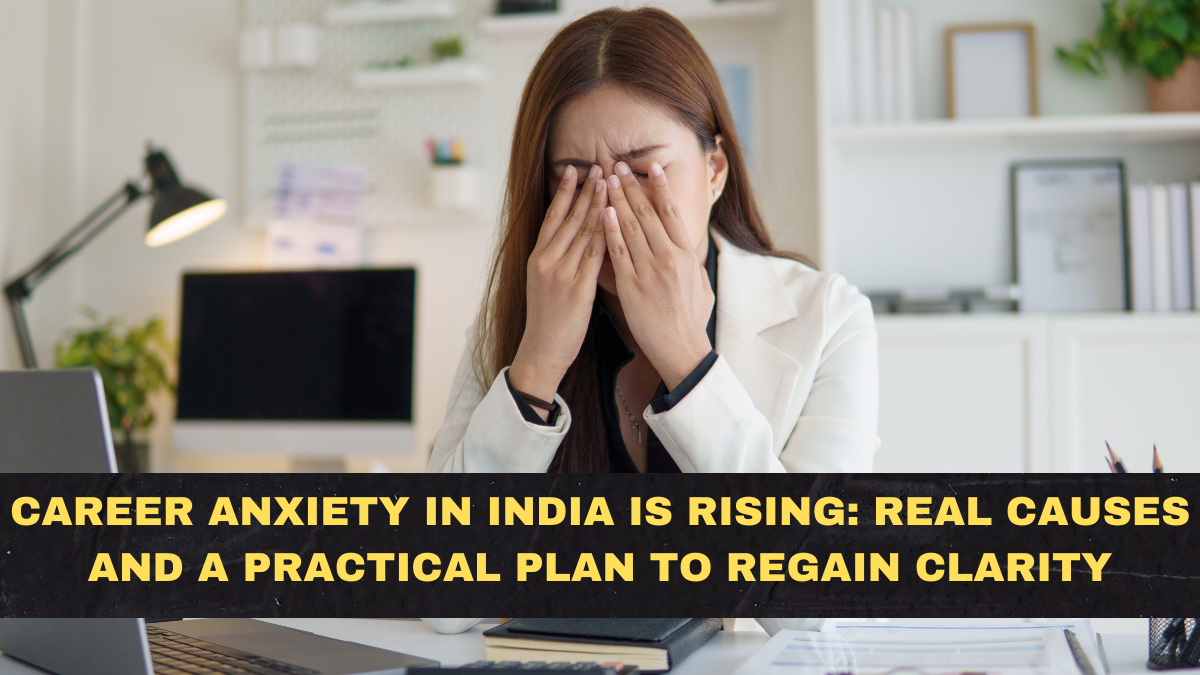
Career anxiety in India has moved from being an occasional worry to a constant background pressure for many students and young professionals in 2026. Even those who are studying well or working in decent roles often feel uncertain, restless, and afraid that they are already falling behind. This anxiety is not limited to one age group or stream. It cuts across students, freshers, and even professionals who appear “settled” from the outside.
What makes this anxiety dangerous is that it often goes unspoken. Families normalize stress, peers glorify hustle, and social media amplifies unrealistic success timelines. As a result, people start questioning their choices daily without having a clear framework to evaluate whether their fear is justified or exaggerated. Understanding career anxiety in India today requires separating real risks from imagined ones and building a plan that restores control instead of panic.
Why Career Anxiety Is Rising Sharply in 2026
One major reason career anxiety is increasing is uncertainty. Job roles are evolving quickly, industries are restructuring, and long-term guarantees feel weaker than before. Even good students worry whether their skills will remain relevant.
Another trigger is comparison overload. Social platforms constantly expose people to curated success stories, creating the illusion that everyone else is progressing faster. This distorts perception and makes normal career timelines feel like failure.
Economic pressure also plays a role. Rising education costs and family expectations make mistakes feel expensive, increasing fear around every decision.
The Difference Between Real Risk and Imagined Fear
Not all career anxiety is irrational. Some concerns are valid signals that something needs attention. The problem begins when fear becomes generalized and detached from facts.
Real risk usually has clear indicators, such as lack of skill development, repeated rejections, or stagnation without learning. Imagined fear, on the other hand, is vague and driven by comparison or hypothetical futures.
In 2026, clarity comes from identifying which category your anxiety falls into. Treating imagined fear like real danger leads to unnecessary panic decisions.
How Family Pressure Amplifies Career Stress
In India, career anxiety rarely exists in isolation. Family expectations add emotional weight to every choice. Even supportive families may unintentionally increase pressure through constant reminders about age, peers, or financial responsibility.
This creates a conflict where individuals feel guilty for exploring options or taking time to experiment. Fear of disappointing others often overrides personal judgment.
Reducing career anxiety requires reframing conversations at home from outcome obsession to progress-focused discussions.
Why Panic Decisions Make Anxiety Worse
When anxiety peaks, many people rush into decisions just to escape discomfort. Switching fields impulsively, enrolling in random courses, or accepting unsuitable jobs often brings temporary relief followed by deeper regret.
These panic decisions rarely address the root cause of anxiety. Instead, they add new problems such as financial strain, skill mismatch, or loss of confidence.
In 2026, slowing down to think clearly is often more productive than rushing to act.
A Practical Framework to Regain Career Clarity
Regaining clarity starts with narrowing focus. Instead of thinking about “the entire future,” focus on the next twelve to eighteen months. This reduces overwhelm and makes planning actionable.
The next step is skill audit. Identify what you can already do well and what the market actually rewards. This grounds decisions in reality rather than fear.
Finally, create small experiments instead of irreversible commitments. Short projects, internships, or certifications allow testing direction without high risk.
Daily Habits That Reduce Career Anxiety Over Time
Career anxiety feeds on uncertainty and inactivity. Small, consistent actions reduce both. Regular learning blocks, even short ones, restore a sense of progress.
Limiting comparison triggers is equally important. Reducing exposure to unrealistic content helps reset expectations.
Physical routine, sleep, and movement also play a larger role than most people admit. Mental clarity is harder to achieve when the body is exhausted.
When Anxiety Signals a Deeper Problem
Sometimes career anxiety is not just about work. It can reflect deeper issues such as burnout, loss of self-worth, or prolonged stress.
If anxiety persists despite structured planning and action, it may require professional support. Ignoring these signs often worsens both career and mental health.
Seeking help is not weakness. In 2026, it is a rational response to sustained pressure.
Conclusion: Anxiety Reduces When Control Returns
Career anxiety in India is rising because control feels lost. Too many variables, opinions, and uncertainties compete for attention. The solution is not certainty, but clarity.
When individuals understand their real risks, filter noise, and take structured action, anxiety naturally reduces. Progress replaces panic, and confidence rebuilds gradually.
In 2026, managing career anxiety is not about eliminating fear. It is about learning to act intelligently despite it.
FAQs
Is career anxiety normal in 2026?
Yes, it is common due to market uncertainty, competition, and changing career paths, but it should be managed constructively.
How do I know if my anxiety is justified?
Evaluate tangible indicators like skill gaps or repeated setbacks instead of vague fears or comparisons.
Can career anxiety affect performance?
Yes, prolonged anxiety reduces focus, confidence, and decision quality over time.
Should I switch careers to escape anxiety?
Not immediately. Anxiety should be addressed first to avoid impulsive decisions.
How long does it take to regain clarity?
With consistent action and realistic planning, many people regain clarity within a few months.
When should I seek professional help?
If anxiety interferes with daily functioning or persists despite planning and action, professional support is advisable.