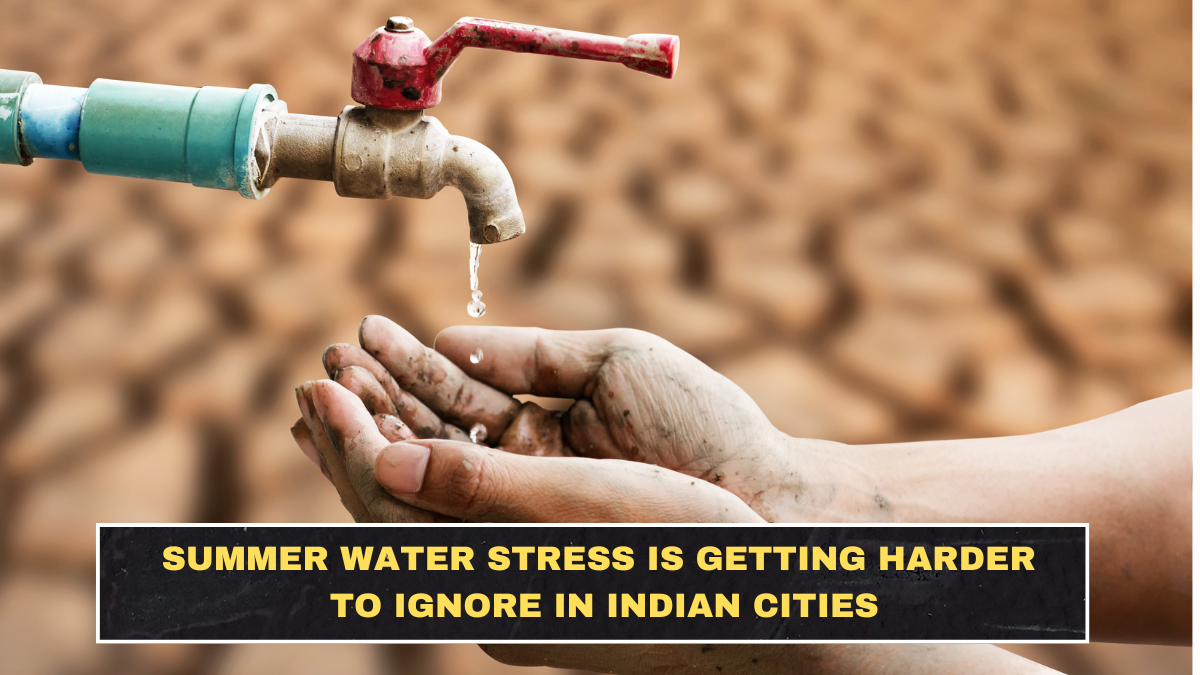
Indian cities are entering summer with the same problem they keep pretending is temporary: demand rises fast, supply systems stay weak, and groundwater keeps getting squeezed. This year, the pressure is already visible. In Bhopal, the municipal estimate is that peak water demand could rise to 470 million litres per day (MLD) from an average 440 MLD, while Rajasthan has launched a statewide summer contingency plan and allocated more than ₹200 crore for drinking water arrangements across urban and rural areas.
The pattern is simple. Heat does not just raise drinking-water use. It increases storage demand, household washing needs, tanker dependence, and pressure on already leaky city networks. Reuters reported on March 27 that hotter conditions in 2026 are expected to add stress to India’s urban water systems, not just its power grid.
What Jaipur and Rajasthan are already doing
Rajasthan is not waiting for May to panic. State officials have allocated ₹55 crore for urban areas and ₹154.83 crore for rural areas for summer drinking water management, plus more than ₹100 crore for water transport to vulnerable last-mile localities. The programme runs across all 41 districts from April 1 to July 31, with district control rooms, contingency funds, hired vehicles, and extra labour support.
PHED’s follow-up summer plan also shows the state knows the system is under strain. Officials were directed to act against illegal water connections and booster pumps, complete sanctioned works by April 30, and commission hand pumps and tube wells by April 15. The reason given was blunt: rising temperatures, depleting surface sources, and falling groundwater levels.
Why Bhopal is a good warning sign
Bhopal’s numbers are more useful than broad speeches because they show the scale of the squeeze. Peak demand is projected at 470 MLD, but the city’s current average is 440 MLD. Around 70% of its supply depends on the Narmada and Kolar pipelines, while the remaining 30% comes from the Upper Lake. The Kolar treatment plant is already operating around 162 MLD against a stated 153 MLD capacity, leaving very little room for disruption.
The bigger issue is what comes next. Bhopal is projected to need about 541 MLD by 2030, meaning it has already reached about 86% of that future requirement. The city now has to find another 71 MLD within four years. That is not a distant planning issue. That is a present-capacity warning.
What the data says in simple terms
| City / state | Verified number | What it shows |
|---|---|---|
| Bhopal | 470 MLD projected summer peak demand | Demand is rising above current average use |
| Bhopal | 440 MLD current average demand | The summer increase is not trivial |
| Rajasthan | ₹200+ crore summer allocation | Water stress is serious enough to trigger statewide contingency planning |
| Rajasthan | 41 districts covered from April 1–July 31 | The risk is broad, not localised |
| Bhopal | 71 MLD additional need by 2030 | Cities are running too close to future limits already |
What households should understand
The mistake people make is assuming this is only a “rural water scarcity” issue. It is not. In cities, the early damage usually shows up as:
- irregular supply hours
- low pressure in upper floors and dense colonies
- more tanker dependence
- worse service in leak-prone and fast-growing areas
That is why this story matters for households now, not later. Reuters noted that wastewater reuse is becoming more important as heat and urban growth put more pressure on city supplies. That tells you the old model of simply pumping more fresh water is getting weaker.
Conclusion
Summer water stress is getting harder to ignore because the data is no longer subtle. Rajasthan is already in contingency mode, and Bhopal is already operating close to future demand limits. The real problem is not just low rainfall or one bad season. It is that many Indian cities still run fragile supply systems while demand keeps rising faster than planning quality. That is why summer now exposes urban water weakness so quickly.
FAQs
Why are Indian cities facing more water stress in summer 2026?
Because heat is pushing up demand while many cities still depend on strained pipelines, weak storage, and stressed groundwater-backed systems.
What is happening in Rajasthan right now?
Rajasthan has launched a summer contingency plan across 41 districts and allocated more than ₹200 crore for drinking water supply arrangements.
How serious is Bhopal’s water demand problem?
Bhopal expects peak demand of 470 MLD against a current average of 440 MLD, and it needs to add 71 MLD by 2030 to keep up with projected requirements.
Is this only about shortages?
No. It is also about leaks, pressure drops, overloaded treatment systems, and dependence on emergency fixes like tankers and temporary augmentation works.