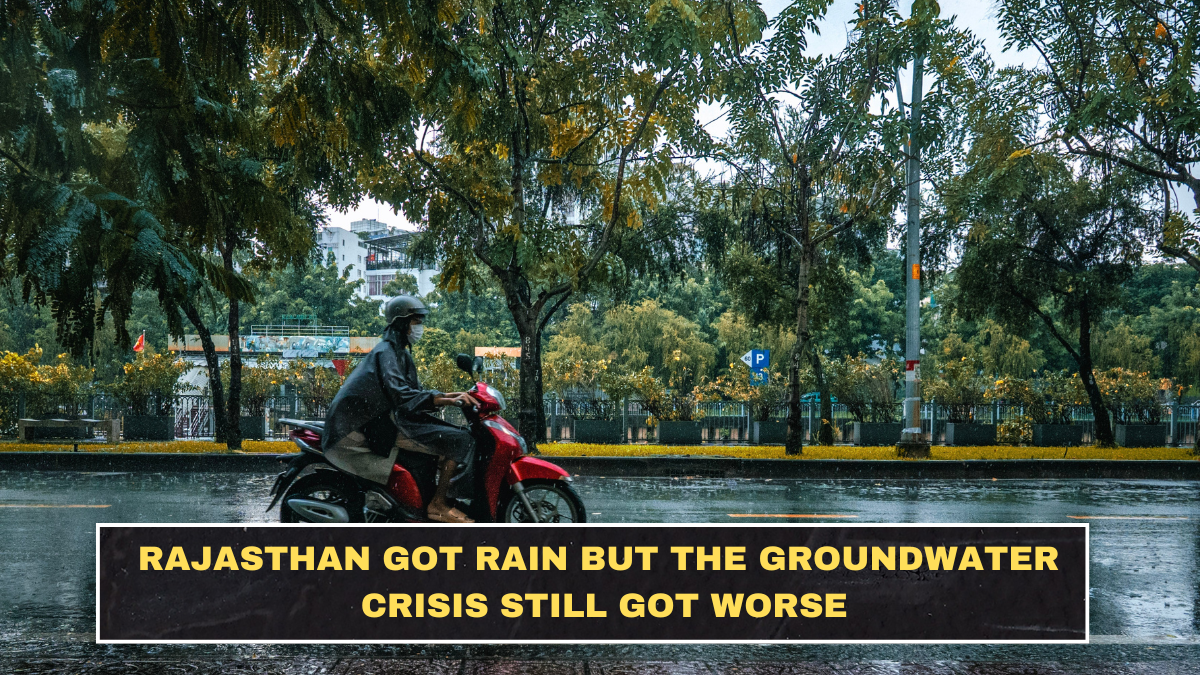
Rajasthan got unusually strong rain, but the groundwater crisis still worsened. That is the real story, and it destroys the lazy assumption that a good monsoon automatically fixes water stress. According to recent reporting based on the Central Ground Water Board’s 2024–25 assessment, 214 of Rajasthan’s 302 assessed groundwater units are now classified as overexploited, which is more than 70% of the total. The state also received about 156% of its long-period average rainfall in 2024, yet groundwater stress still deepened.
This is not a small policy failure. At the national level, the 2025 groundwater assessment put India’s overall stage of groundwater extraction at 60.63%, but Rajasthan was one of only a few states above 100%. A parliamentary reply cited in recent reporting placed Rajasthan’s stage of extraction at 147.11%, meaning the state is drawing far more groundwater than is sustainably replenished.
What the data actually shows
The simplest way to understand the problem is this: rainfall and recharge are not the same thing. Rajasthan can receive heavy rain and still fail to store enough water underground if runoff escapes quickly, recharge structures are weak, land use is poor, and extraction remains aggressive. Reporting from Jaipur highlighted districts like Dausa and Sawai Madhopur, where blocks remained heavily overexploited despite high rainfall.
| Indicator | Verified number | What it means |
|---|---|---|
| Assessed groundwater units in Rajasthan | 302 | Total units reviewed in the recent assessment |
| Overexploited units | 214 | More than 70% are drawing too much groundwater |
| Rajasthan stage of extraction | 147.11% | Extraction is far above sustainable recharge |
| India stage of extraction | 60.63% | Rajasthan is far worse than the national average |
| 2024 rainfall in Rajasthan | 156% of long-period average | Strong rain did not translate into enough groundwater recovery |
Why the rain did not solve the problem
The main reason is over-pumping, especially for agriculture. Recent reporting said agriculture uses nearly 85% of Rajasthan’s groundwater. That means even a strong monsoon struggles to offset what is being extracted through borewells and irrigation in water-stressed areas. In western districts such as Barmer and Jodhpur, deep borewell extraction has become common, while traditional wells continue to dry up.
There is also a structural problem. Heavy rainfall often arrives in short bursts, which increases runoff instead of deep recharge unless local storage, ponds, check dams, and recharge systems are working properly. So when people say, “But Rajasthan had a good monsoon,” they are missing the point. Rainfall volume alone is not the same as groundwater recovery. That thinking is shallow, and the data exposes it.
Where the pressure is worst
The crisis is not only about quantity. It is also about quality. A January 2026 CGWB-linked report found high fluoride contamination across more than 30 districts in Rajasthan, with 41 of 643 tested samples exceeding the safe fluoride limit of 1.5 mg/L. That matters because overexploitation does not just lower water tables. It can worsen salinity and contamination risks too.
Recent parliamentary data also highlighted how severe the district-level stress has become. Jaisalmer was cited as the worst-affected district nationally on one over-extraction measure, while other Rajasthan districts also remain deep in the danger zone. This means the state is not facing a single local problem. It is dealing with a broad groundwater management failure.
What needs to change
A few facts are hard to avoid:
- Rajasthan cannot irrigate its way out of this with the current crop-water pattern.
- Better rain alone will not fix overexploited aquifers.
- Groundwater quality risks, especially fluoride, make the crisis worse for households.
- The state needs stricter extraction control, stronger recharge systems, and more realistic crop planning. That is also the direction flagged in recent CGWB-based reporting.
Conclusion
Rajasthan’s groundwater crisis got worse even after heavy rain because the real problem is not just rainfall shortage. It is chronic over-extraction, weak recharge, and poor water-use choices. With 214 of 302 groundwater units overexploited and extraction at 147.11%, the state is using groundwater like a credit card it cannot repay. That is the uncomfortable truth, and until policy matches that reality, good monsoons will keep producing bad outcomes.
FAQs
How many groundwater units in Rajasthan are overexploited?
Recent reporting based on the 2024–25 assessment said 214 out of 302 assessed units in Rajasthan are overexploited.
If rainfall was high, why did the crisis worsen?
Because rainfall does not automatically become recharge. Fast runoff, weak storage, and continued heavy extraction can cancel out the benefit of a good monsoon.
How bad is Rajasthan compared with the national picture?
India’s 2025 groundwater extraction stage was 60.63%, while Rajasthan’s was reported at 147.11%, showing much higher stress.
Is groundwater quality also a problem in Rajasthan?
Yes. A 2026 CGWB-linked report highlighted fluoride contamination across more than 30 districts in the state.