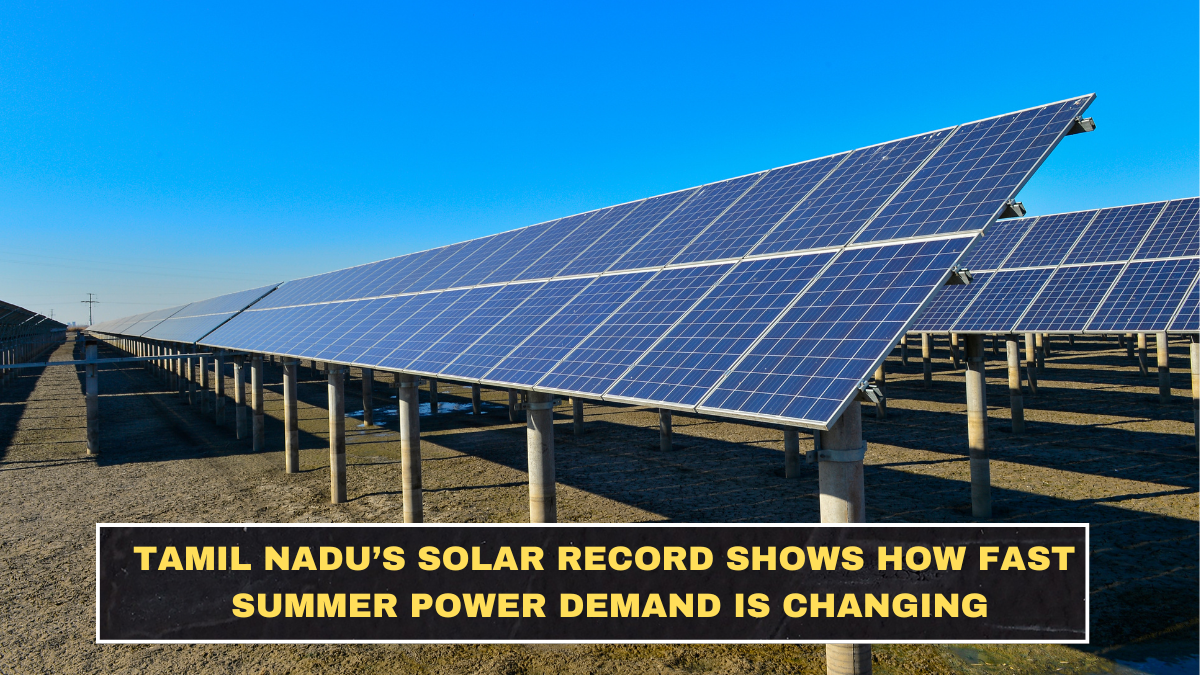
Tamil Nadu’s latest solar record matters for one reason: it shows summer power demand is rising so fast that even record renewable output is now being treated as a daily necessity, not a bonus. On Friday, the state absorbed 55.60 million units (MU) of solar power, slightly above the previous day’s 55.50 MU, while total electricity consumption climbed to 428.28 MU and peak demand reached 20,146 MW. TNPDCL also evacuated 7,189 MW of solar power that day.
That is the real story. Tamil Nadu is not just generating more solar power because it wants cleaner headlines. It is leaning harder on solar because early summer demand is arriving with force. A few weeks earlier, the state had already crossed 20,211 MW of peak demand in early March, nearing the all-time high of 20,830 MW recorded in 2024. On that day, solar generation peaked at 7,107 MW, and daily solar absorption hit 53.7 MU, then rose again to the new record later in March.

What the latest numbers actually show
The cleanest way to read these numbers is this: demand is rising early, and solar is helping the grid avoid greater strain during the daytime. TNPDCL’s reported 428.28 MU of total consumption is the highest so far in 2026 and already above the 425 MU peak recorded in 2025, though still below the all-time high of 454.32 MU from April 2024. That means Tamil Nadu is seeing strong summer pressure before the hottest stretch is fully underway.
Here is the simpler breakdown:
| Indicator | Verified 2026 number | Why it matters |
|---|---|---|
| Solar energy absorbed | 55.60 MU | New single-day solar record |
| Solar evacuated | 7,189 MW | Shows solar is carrying serious daytime load |
| Total electricity consumption | 428.28 MU | Highest in 2026 so far |
| Peak power demand | 20,146 MW | Summer pressure is already high |
| Installed solar capacity | 9,555 MW | State has large solar base to draw from |
Why this matters for grid stability
Solar is clearly helping Tamil Nadu manage daytime demand. If the state can evacuate over 7 GW of solar during a high-demand day, it reduces the burden on more expensive or more stressed sources during sunlight hours. That is a real grid advantage, especially when temperatures rise and cooling demand jumps.
But there is a limit people keep ignoring. Solar helps most in the daytime. The harder problem is still the evening peak, when solar output falls but homes and businesses keep using air conditioners, fans, and appliances. That is why TNPDCL has also tied up power through long-term, medium-term, and short-term contracts with private generators to handle rising summer demand. In plain terms, solar is helping, but solar alone is not enough.
What it says about Tamil Nadu’s energy planning
Tamil Nadu is already planning for further demand growth. A regulatory filing cited demand projections from the Central Electricity Authority showing the state’s peak demand rising from 19,409 MW in 2023–24 to 26,046 MW by 2028–29, and then to 35,507 MW by 2034–35. That is why the state is seeking more flexible renewable procurement, not just more raw capacity.
This is where many readers fool themselves. They see a solar record and assume the system is now comfortable. It is not. A solar record usually means the grid needed that output badly. The faster demand grows, the more important storage, balancing power, and smarter procurement become. Otherwise, a state can look strong at noon and stressed by evening.
What consumers should take from this
A few practical points matter most:
- Tamil Nadu’s power demand is rising earlier in the year than many people expect.
- Solar is now a major daytime support, not a side contribution.
- High solar output does not eliminate evening or peak-summer risk.
- The state’s long-term planning assumes much higher future peak demand, so today’s records are probably not the ceiling.
Conclusion
Tamil Nadu’s solar record shows how fast summer power demand is changing because the state is setting new highs in both electricity use and renewable contribution at the same time. The numbers are impressive, but they are also a warning. Record solar absorption is helping the grid hold up during the day, yet rising demand means Tamil Nadu still needs stronger balancing capacity and tighter planning for the hours when solar fades.
FAQs
What was Tamil Nadu’s latest solar generation record?
TNPDCL reported solar absorption of 55.60 million units in a single day, with 7,189 MW evacuated.
How high has Tamil Nadu’s power demand gone in 2026?
Recent reports put peak demand at 20,146 MW on the record-solar day, and 20,211 MW earlier in March.
Does higher solar output mean the grid problem is solved?
No. Solar helps strongly in daytime, but evening demand remains harder to manage once solar output falls.
Why is Tamil Nadu planning more renewable procurement?
Because official projections show peak demand could rise to 26,046 MW by 2028–29 and 35,507 MW by 2034–35.