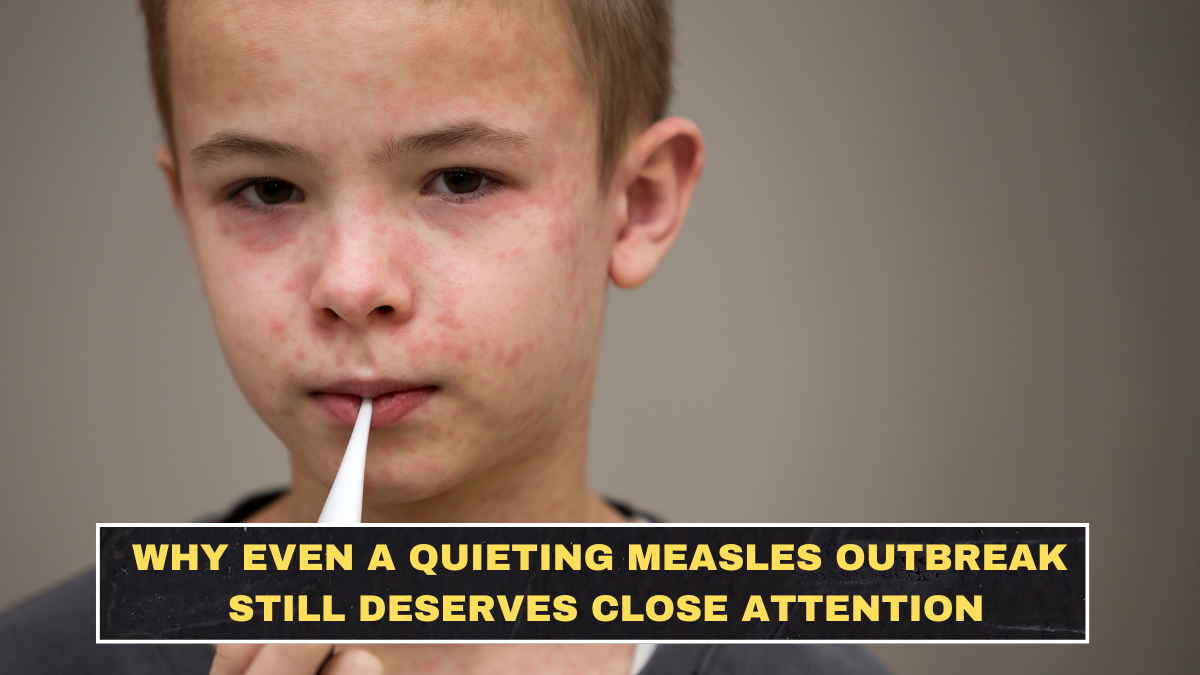
South Carolina’s measles outbreak may be nearing its official end, but calling that “all clear” right now would be sloppy. Reuters reported on March 25 that the state could declare the outbreak over by April 26, 2026 if no additional cases are reported. That is encouraging, but it is conditional, not final. Health officials are still watching because measles outbreaks are only declared over after 42 days without a new infection, which is double the virus’s typical 21-day incubation period.
Why South Carolina is still being watched
This is not a small outbreak fading quietly in the background. South Carolina’s Department of Public Health said the outbreak total reached 997 cases as of March 27, 2026, centered around Spartanburg County, and the agency warned that public exposure sites show measles had been circulating in the community. Reuters also reported on March 13 that the outbreak total had already climbed to 996 before the most recent update. That scale alone is enough reason for caution.
Why “no new cases” does not mean “no risk”
The dangerous mistake is assuming silence equals safety. Reuters reported that the outbreak could end by April 26 only if no more infections are found, while South Carolina public radio reported that officials remain concerned about unrecognized transmission, especially after travel and spring-break mixing. Health agencies worry not only about confirmed cases but also about missed chains of infection in under-vaccinated communities.
The national picture is still bad
Another reason officials are cautious is that the broader U.S. measles situation is still serious. CDC data showed 1,575 confirmed measles cases in the United States as of March 26, 2026, with cases reported across 32 jurisdictions. The American Hospital Association, citing CDC data, also noted that about 5% of cases had been hospitalized and that 92% of cases were either unvaccinated or had unknown vaccination status. So even if South Carolina is improving, the national environment is still supportive of fresh spread.
What the timeline actually means
Here is the simple breakdown:
- last reported South Carolina cases held the outbreak total at 997 as of late March
- the state can declare the outbreak over on April 26 only if there are no new cases
- the waiting period is 42 days, not a random number
- officials are still monitoring for missed or delayed diagnoses
The key facts at a glance
| Measure | Current reported figure | Why it matters |
|---|---|---|
| South Carolina outbreak total | 997 cases | Shows this was a major outbreak, not a minor cluster |
| Potential end date | April 26, 2026 | Only applies if no new cases appear |
| Outbreak-free waiting period | 42 days | Standard public-health threshold |
| U.S. confirmed measles cases | 1,575 | National spread is still significant |
| Share unvaccinated or unknown | 92% | Explains why outbreaks keep gaining traction |
The table makes the real point obvious: South Carolina may be improving, but the conditions that help measles spread have not disappeared nationally.
Why vaccination is still the core issue
There is no clever way around this: outbreaks like this stay alive where immunity gaps exist. CDC’s South Carolina scenario assessment said Spartanburg County had lower MMR coverage than the state average and identified a large close-knit community with low vaccination coverage as part of the outbreak context. That matters because measles is one of the most contagious viruses in public health, so even small immunity gaps can produce very large outbreaks.
What readers should watch next
The useful signals are straightforward:
- whether South Carolina reports any new cases before April 26
- whether new public exposure sites are announced
- whether national case counts keep rising
- whether local vaccination outreach expands in under-immunized areas
Conclusion
South Carolina’s measles outbreak may be slowing, and that is real progress. But progress is not the same as safety, and an outbreak this large does not deserve lazy optimism. The state can declare it over by late April only if the current quiet period holds. Until then, officials are right to stay cautious, because measles punishes overconfidence faster than most people realize.
FAQs
When could South Carolina officially declare the measles outbreak over?
If no new cases appear, the state could declare the outbreak over on April 26, 2026.
How many measles cases has South Carolina reported?
The South Carolina Department of Public Health reported 997 cases as of March 27, 2026.
Why are officials still cautious if cases have slowed?
Because outbreaks are only considered over after 42 days without a new infection, and officials are still concerned about undetected transmission.
How serious is the national measles situation in 2026?
CDC reported 1,575 confirmed U.S. cases as of March 26, 2026, across 32 jurisdictions.