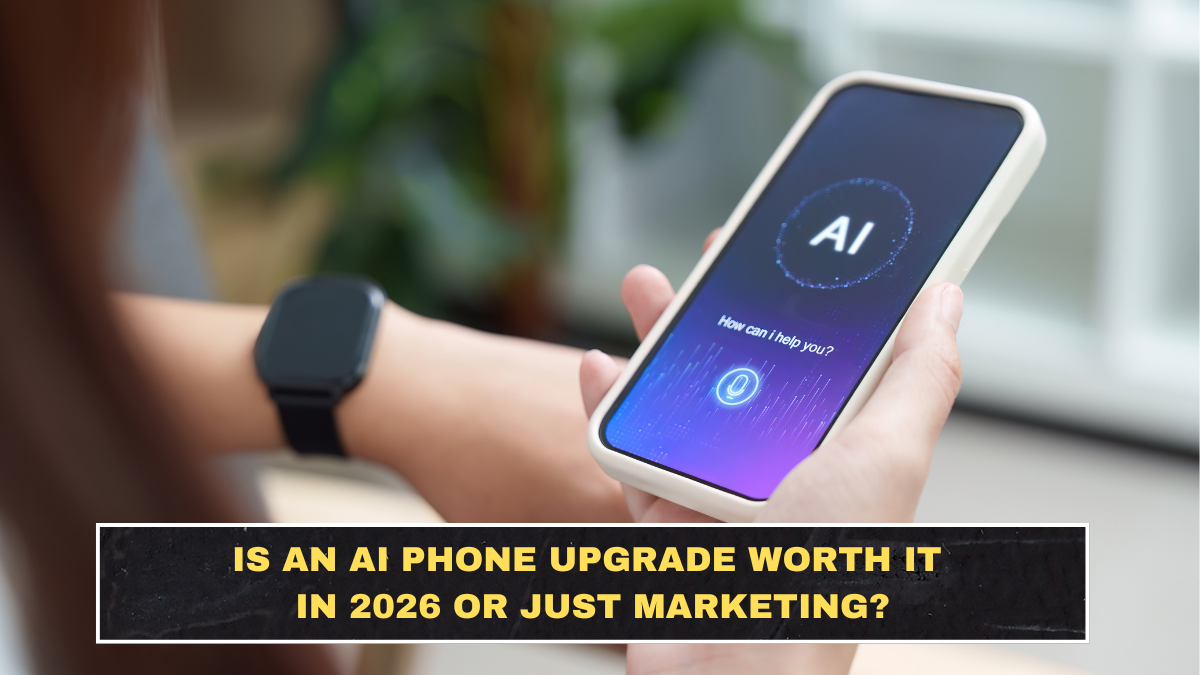
AI phones are being pushed hard in 2026, but most buyers need to stop and think before spending. The market is clearly moving this way. Counterpoint Research said cumulative GenAI smartphone shipments had already passed 500 million by late 2025 and were projected to cross 1 billion by Q3 2026, which shows AI phones are becoming mainstream, not niche.
The problem is that “AI phone” means very different things depending on the device. Some phones offer useful on-device features like writing help, photo cleanup, live translation, and visual search. Others mostly offer branding and a newer chip. Qualcomm says on-device AI improves privacy and lowers latency because data can stay on the phone instead of going to the cloud. That benefit is real, but only if the features are ones you will actually use.
What do AI phones actually do in 2026?
The useful AI features are now pretty clear. Apple Intelligence supports Writing Tools, notification and message summaries, image cleanup, visual intelligence, and actions like turning a poster into a calendar event or searching what is on your screen. Samsung’s Galaxy S26 line is pushing Galaxy AI along with a stronger NPU on the Snapdragon 8 Elite Gen 5 for Galaxy, which Samsung says delivers a 39% NPU boost on the S26 Ultra.
That sounds impressive, but here is the blunt truth: if your current phone already handles your apps smoothly and you barely use features like translation, AI writing, visual search, or advanced photo editing, an “AI upgrade” alone is weak justification. Buying new hardware for features you will touch twice is how people waste money.
When is an AI phone upgrade actually worth it?
An AI phone upgrade makes sense when the AI features solve repeated daily problems. That usually means frequent document work, lots of messaging, travel, translation, camera-heavy use, or real benefit from on-device privacy and faster response. Apple and Qualcomm both emphasize that local AI is useful for speed, responsiveness, and privacy-sensitive tasks.
It also makes more sense if your current phone is already old enough to be missing the hardware needed for newer AI features. Apple’s support documentation makes clear that Apple Intelligence only works on supported devices, and Samsung is heavily tying its newest Galaxy AI experience to the latest flagship hardware. So in many cases, the real issue is not hype but hardware eligibility.
When is it mostly just marketing?
It is mostly marketing when the pitch is vague, the features overlap with cloud tools you already use, or the upgrade cost is huge compared with the actual time saved. Many people already use AI through apps, web tools, and cloud services without needing a brand-new flagship. If your current phone still performs well, battery life is acceptable, and camera quality is good enough, waiting is often the smarter move. That is especially true because the AI phone market is still maturing quickly, and features are improving every cycle.
How should buyers decide in 2026?
| Situation | Upgrade now? | Why |
|---|---|---|
| Current phone is 3 to 5 years old and slowing down | Yes, often | You get both normal hardware gains and newer AI features |
| You use translation, summaries, writing tools, or visual search often | Yes, maybe | Daily utility can justify the price |
| Your phone is still fast and you barely use AI features | Usually no | The value is more marketing than real benefit |
| You care strongly about on-device privacy and speed | More likely yes | Local AI can reduce cloud dependence |
| You only want “the latest AI phone” | No, probably not | That is branding, not a buying strategy |
This is the simple answer most buyers need. If AI features solve real friction every week, the upgrade can make sense. If not, do not let advertising trick you into paying flagship prices for a future you are not actually using.
What is the bottom line?
An AI phone upgrade in 2026 is worth it for people whose daily habits match the new features and whose current hardware is already aging. For everyone else, the “AI phone” label is often more marketing than necessity. The smarter question is not whether the phone has AI. It is whether that AI saves you enough time, effort, or privacy risk to justify the price.
FAQs
Are AI phones becoming mainstream in 2026?
Yes. Counterpoint projected cumulative GenAI smartphone shipments to exceed 1 billion units by Q3 2026, showing the category is moving into the mainstream.
What are the most useful AI phone features right now?
Writing help, summaries, photo cleanup, live translation, and visual search are among the most practical features currently promoted by Apple and Samsung.
Does on-device AI really matter?
Yes, especially for privacy and speed. Qualcomm says on-device AI can reduce latency and keep more data on the device instead of sending it to the cloud.
Should everyone upgrade to an AI phone in 2026?
No. If your current phone still works well and you do not regularly use AI-heavy features, upgrading mainly for the label is usually a bad value decision.