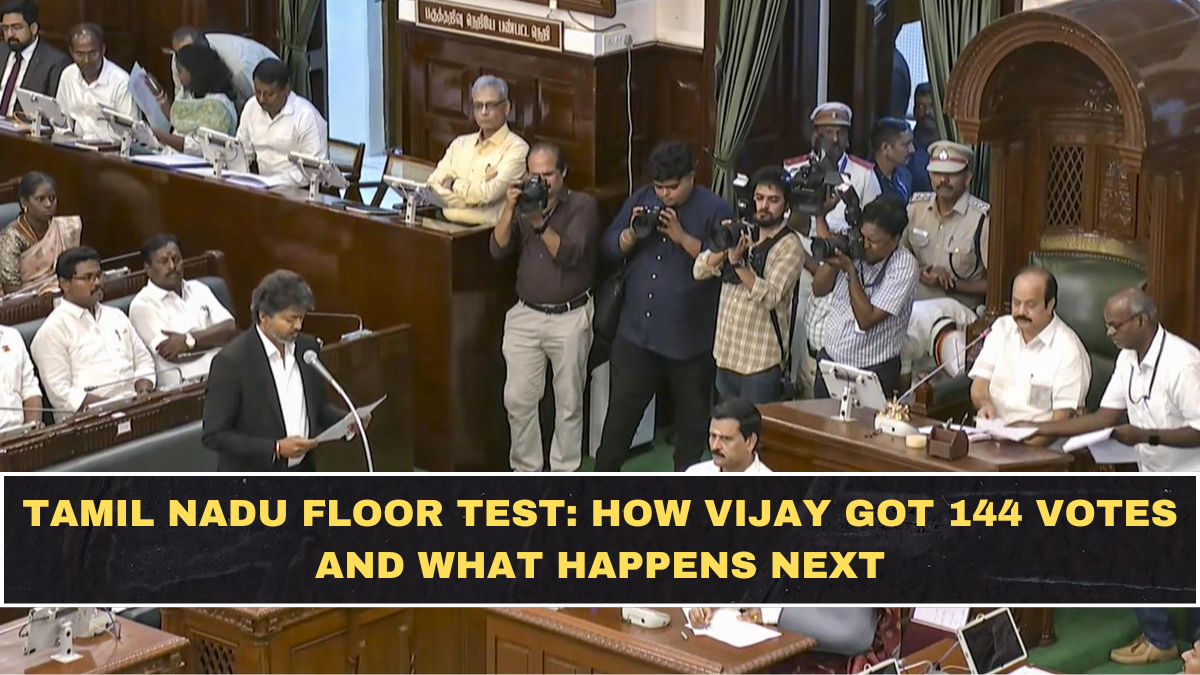
Vijay’s TVK government cleared the Tamil Nadu Assembly floor test with 144 votes in favour, 22 against and five abstentions, turning a tense confidence vote into a major political statement. The result gave Vijay a comfortable Assembly number, but it also exposed how unstable the opposition camp has become after the election.
The shocking part is not only the number; it is how that number was achieved. TVK had reportedly emerged short of a direct majority on its own, so the floor test became a test of alliance management, rebel support and opposition discipline. Vijay won that test, but the real governance challenge starts now.
How Did Vijay Reach 144 Votes?
The floor test was shaped by support from TVK allies, smaller groups and rebel voting from AIADMK MLAs. Reports said several AIADMK MLAs defied party instructions and voted in Vijay’s favour, while the DMK staged a walkout during the proceedings. That combination helped TVK cross the majority mark comfortably.
This is where the result becomes politically explosive. A chief minister can claim majority after a trust vote, but when that majority depends partly on rival-party rebels, the story does not end inside the Assembly. It moves into party offices, legal complaints, future bypoll fears and daily pressure on the new government.
| Floor Test Factor | What Happened? | Why It Matters? |
|---|---|---|
| Votes in favour | 144 MLAs backed Vijay | Clear majority proved |
| Votes against | 22 MLAs opposed | Opposition looked weak |
| Abstentions | 5 MLAs stayed away | Signals political caution |
| AIADMK role | Rebels backed TVK | Party split became visible |
| DMK role | Walkout reported | Opposition strategy questioned |
Why Is AIADMK In Trouble Now?
AIADMK’s problem is serious because floor tests expose discipline better than speeches do. NDTV reported that 24 AIADMK MLAs voted for Vijay despite Edappadi K Palaniswami’s order, while one pro-TVK legislator reportedly abstained. That kind of public split makes a party look weak at the exact moment it needs to look united.
For Vijay, this is a gift, but for AIADMK, it is a warning. If MLAs keep drifting toward TVK, AIADMK risks losing not just Assembly strength but also cadre confidence. In Tamil Nadu politics, perception matters heavily, and a split opposition gives the ruling side more room to dominate the narrative.
What Happens Next For Vijay?
Vijay has won the floor test, but pretending this means easy governance would be foolish. A trust vote gives survival, not stability. He now has to keep allies satisfied, manage rebel supporters, avoid administrative mistakes and deliver quickly enough to prove TVK is more than a celebrity-powered political wave.
The next pressure points are clear:
- Keeping supporting MLAs loyal without creating internal resentment
- Handling AIADMK rebels without triggering bigger legal or political backlash
- Responding to DMK’s criticism over mandate and governance
- Moving from campaign promises to visible public delivery
- Avoiding controversies that make TVK look inexperienced
- Building a stable cabinet and legislative strategy
Is This A Strong Mandate Or Smart Arithmetic?
This is where Vijay’s team should not fool itself. The 144-vote figure is strong inside the Assembly, but critics are already questioning whether it reflects a deep public mandate or clever post-election arithmetic. Udhayanidhi Stalin reportedly attacked the government’s mandate, arguing that a large share of voters did not back TVK.
That criticism will not remove Vijay from power, but it will shape the opposition’s attack line. TVK must now prove that its majority is not just a floor-test number but a working government. If governance is weak, opposition parties will call the mandate artificial; if delivery is strong, the same 144 votes will look like the birth of a new political centre.
What Is The Conclusion?
The Tamil Nadu floor test has given Vijay a powerful opening, but not a free pass. Winning 144 votes proves that TVK can command Assembly support, yet the method of that win also shows how fragile Tamil Nadu’s new political balance may be. This is not the end of the drama; it is the beginning of a harder phase.
Vijay’s biggest test now is not defeating the opposition on paper. It is proving that his government can stay disciplined, deliver policies and manage a mixed support base without collapsing into daily political bargaining. If he handles that well, this floor test may become a turning point in Tamil Nadu politics.
What Are The Biggest FAQs?
How Many Votes Did Vijay Get In The Tamil Nadu Floor Test?
Vijay’s TVK government secured 144 votes in favour during the Tamil Nadu Assembly floor test. Reports said 22 MLAs voted against the confidence motion, while five abstained from voting.
Why Did The AIADMK Split Matter So Much?
The AIADMK split mattered because several of its MLAs reportedly voted in favour of Vijay despite the party leadership’s stand. This weakened the opposition’s image and helped TVK prove its majority more comfortably.
Did DMK Vote Against Vijay?
Reports said DMK MLAs staged a walkout during the Assembly proceedings. That move became part of the larger floor-test drama because it affected the optics of opposition unity and resistance.
Is Vijay’s Government Fully Stable Now?
Not fully. The trust vote proves Vijay has Assembly support right now, but long-term stability depends on managing allies, rebels, cabinet expectations and opposition attacks. The number is strong, but the political base still needs careful handling.