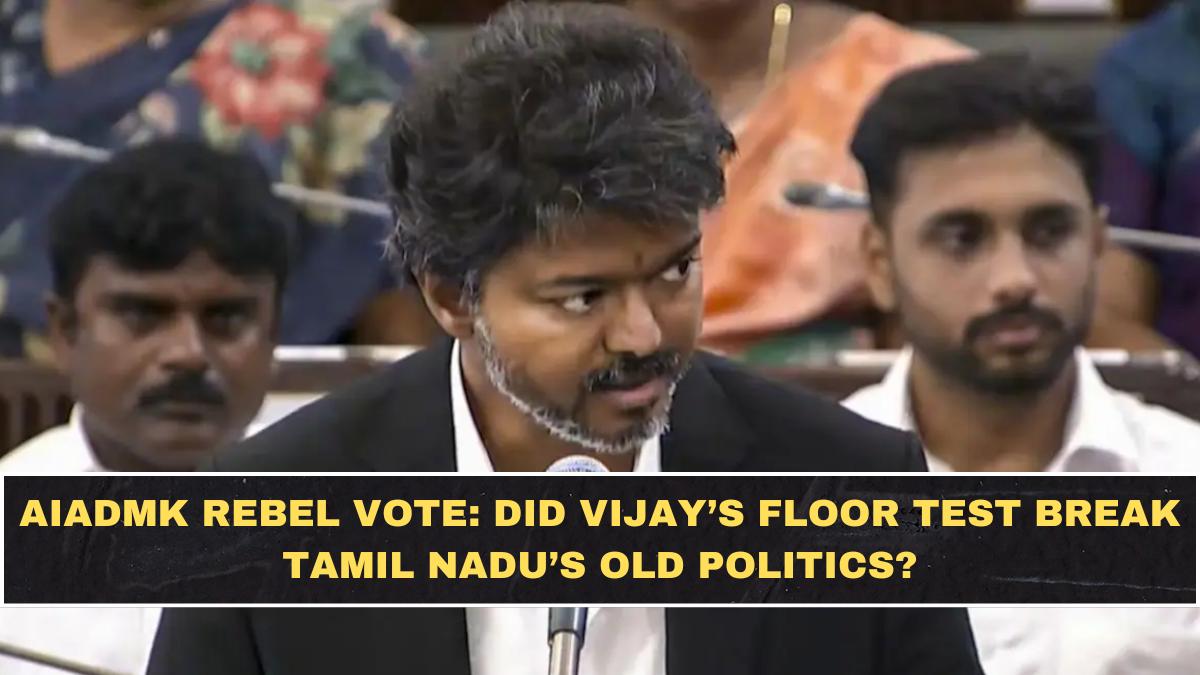
The AIADMK rebel vote has become the biggest political twist in Vijay’s Tamil Nadu floor test. Vijay’s TVK government won the confidence motion with 144 votes in favour, while 22 MLAs opposed and five abstained. The shock came because a section of AIADMK MLAs reportedly defied Edappadi K. Palaniswami’s order and backed Vijay, turning the vote into a public exposure of AIADMK’s internal fracture.
This matters because Tamil Nadu politics has long been shaped by the DMK-AIADMK rivalry. When AIADMK MLAs cross over in a confidence vote, it is not a small rebellion; it is a signal that the old political structure is under stress. Vijay did not just win a number. He forced one of the state’s biggest Dravidian parties to show its weakness on the Assembly floor.
How Many AIADMK MLAs Backed Vijay?
Reports have slightly different numbers, but the political message is the same. NDTV reported that 24 AIADMK MLAs voted for Vijay, while a 25th MLA seen as pro-TVK abstained. Indian Express reported that around 25 AIADMK MLAs cross-voted during the proceedings. Either way, EPS’s command over the party looked badly damaged in the most visible political test of the new government.
| Key Moment | What Happened? | Why It Matters? |
|---|---|---|
| Floor test result | Vijay secured 144 votes | TVK proved majority |
| AIADMK order | EPS wanted MLAs to vote against TVK | Party discipline was tested |
| Rebel vote | 24–25 AIADMK MLAs backed Vijay or defied the line | Internal split became public |
| Leadership action | EPS removed rebel leaders from party posts | Crisis escalated after the vote |
| Bigger impact | AIADMK looked divided | Vijay gained political momentum |
Why Are CV Shanmugam And SP Velumani Important?
CV Shanmugam and SP Velumani became central names because they were linked with the rebel AIADMK faction backing Vijay. India Today reported before the floor test that Vijay met rebel AIADMK leaders Shanmugam and Velumani, who were said to enjoy support from 30 MLAs and had extended support to TVK. That meeting alone showed that Vijay’s camp was not waiting for politics to happen; it was actively pulling power from inside AIADMK’s crisis.
After the floor test, the situation escalated. The Times of India reported that EPS removed rebel leaders, including SP Velumani and C. Ve. Shanmugam, from party posts after they supported Vijay on the Assembly floor. That is not routine discipline. It is damage control after a rebellion became impossible to hide.
Did Vijay Gain Or Did AIADMK Lose?
Both happened, but AIADMK’s loss may be bigger than Vijay’s gain. Vijay already needed numbers to survive the confidence vote, and the rebel support helped him cross that line strongly. But AIADMK suffered a deeper wound because its own MLAs publicly ignored the leadership’s stand at a historic moment.
The brutal truth is that AIADMK cannot blame Vijay for everything. If nearly two dozen MLAs are willing to defy the party line, the problem is not only outside pressure. It is weak leadership, poor internal confidence and a failure to offer a convincing political direction after repeated setbacks.
What Makes This Dangerous For AIADMK?
AIADMK’s danger is not limited to one floor test. Once a rebel camp becomes visible, every future Assembly vote becomes a pressure test. The party may now face questions over loyalty, anti-defection risks, cadre morale and whether EPS can still control the organisation as strongly as before.
The biggest risks ahead are clear:
- Rebel MLAs may demand a bigger say inside the party
- EPS loyalists may push for stronger disciplinary action
- TVK may continue outreach to weaken AIADMK further
- Cadres may lose confidence if leadership looks divided
- Future bypolls or legal fights may deepen the split
- DMK may use the chaos to attack both TVK and AIADMK
Has Vijay Broken The Old Political Pattern?
Vijay has not fully broken Tamil Nadu’s old politics yet, but he has cracked it open. A new party winning power is one story. A new chief minister making AIADMK rebels support him inside the Assembly is a much bigger signal. It shows that TVK is no longer just a campaign brand; it is now a force other MLAs are willing to bet on.
Still, Vijay should not become overconfident. Rebel-backed power can be useful, but it can also become unstable. The same MLAs who help you today may bargain tomorrow. If TVK depends too heavily on fractured opposition support, governance could become a daily negotiation instead of a clean mandate.
Conclusion?
The AIADMK rebel vote has turned Vijay’s floor-test victory into a bigger political earthquake. TVK got the majority it needed, but AIADMK exposed a leadership crisis that may reshape Tamil Nadu politics in the coming months. This was not just cross-voting; it was a public message that EPS’s control is being challenged.
For Vijay, the moment is powerful but risky. He has gained legitimacy, momentum and psychological advantage. But now he must prove that TVK can govern without becoming dependent on unstable rebel arithmetic. Tamil Nadu’s old politics has not ended, but it has definitely been shaken hard.
FAQs?
How Many AIADMK MLAs Voted For Vijay?
NDTV reported that 24 AIADMK MLAs voted for Vijay, while a 25th pro-TVK MLA abstained. Indian Express reported that around 25 AIADMK MLAs cross-voted during the trust vote. The exact framing differs, but both reports confirm a major AIADMK rebellion.
What Action Did EPS Take Against Rebel Leaders?
EPS removed rebel leaders from party posts after they backed Vijay during the floor test. The Times of India reported that the leaders removed included SP Velumani and C. Ve. Shanmugam, showing that the party crisis had moved into disciplinary action.
Why Is The AIADMK Rebel Vote Important?
The rebel vote is important because it exposed a deep split inside AIADMK during a major Assembly test. It helped Vijay prove majority and made AIADMK look internally divided at a time when the party needed unity.
Does This Make Vijay’s Government Stable?
It makes Vijay’s government safer in the short term, but not automatically stable in the long term. Rebel support can help win a floor test, but it can also create future pressure, bargaining and political uncertainty.