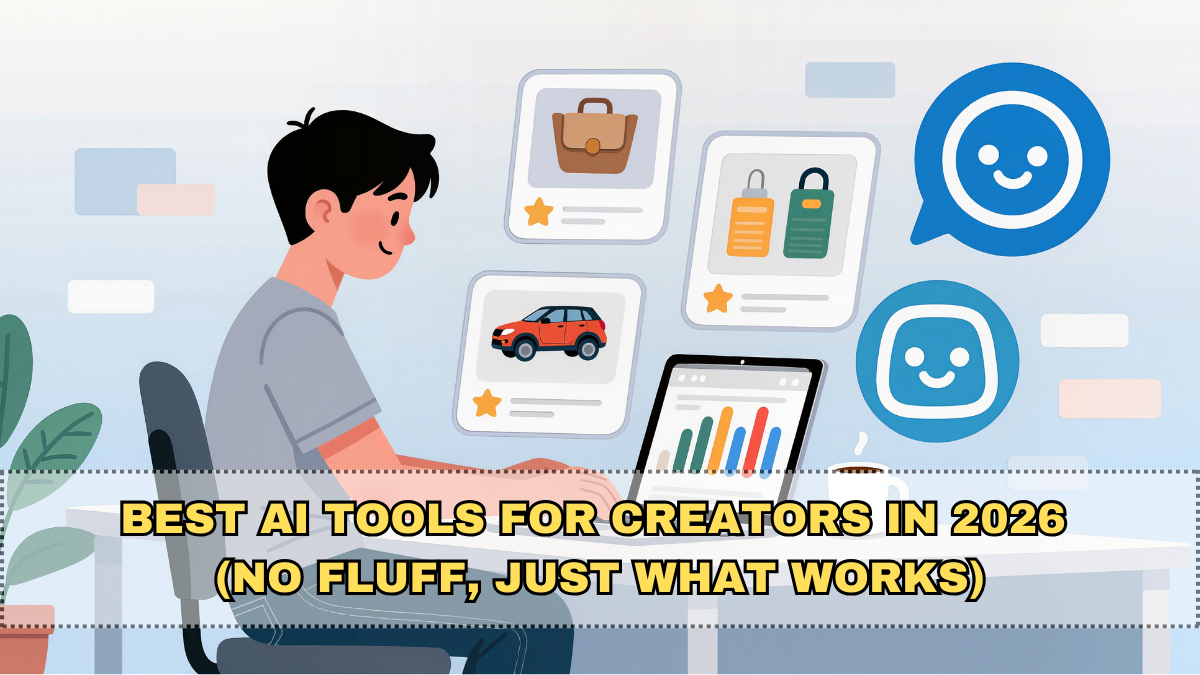
Creators don’t need more tools—they need fewer tools that actually work. In 2026, the gap between impressive demos and usable daily tools is wide. The best AI tools for creators 2026 aren’t the loudest or newest; they’re the ones that save time without wrecking quality, voice, or workflow.
This guide cuts through hype and gives you a clean, realistic AI stack for writing, video, images, and operations—based on what creators are actually using week after week.
How to Judge AI Tools as a Creator (Before We List Any)
Before naming tools, set the filter. If a tool fails these, skip it.
Non-negotiables:
• Improves speed without killing quality
• Fits into an existing workflow
• Produces editable outputs
• Doesn’t force a platform lock-in
The best AI tools for creators 2026 feel boringly reliable.
Writing & Ideation: Where AI Still Delivers the Most ROI
Writing tools remain the strongest category because language models are mature and predictable.
What they’re best for:
• Drafting outlines and first passes
• Repurposing content across platforms
• Tightening clarity and structure
• Overcoming blank-page friction
Tools built on large language models—such as those from OpenAI—work best when you bring the voice and judgment.
Video AI: Speed Up Production, Don’t Automate Creativity
Video AI finally makes sense in 2026—but only in specific stages.
Where video AI helps:
• Script-to-clip rough cuts
• Captioning and subtitle generation
• B-roll suggestions
• Format adaptation (long → short)
Where it still fails:
• Emotional pacing
• Storytelling nuance
• Brand consistency
Use video AI to compress time, not replace direction.
Image AI: From Art Generator to Production Tool
Image AI has matured from novelty to utility.
Best use cases:
• Thumbnail concepts
• Background generation
• Style exploration
• Asset variations
The best AI tools for creators 2026 in images are those that:
• Respect prompt control
• Allow iteration
• Export in production-ready formats
Random “wow” images are useless without consistency.
Audio & Voice AI: Narrow Wins, Clear Limits
Audio AI is powerful—but fragile.
Strong use cases:
• Clean transcription
• Rough voiceovers
• Podcast editing cleanup
Weak areas:
• Emotional delivery
• Long-form narration
• Unique vocal identity
Treat audio AI as a helper, not a performer.
Creator Operations: The Quiet Superpower Category
This is where AI saves the most invisible time.
Operational tools help with:
• Content calendars
• Title and description variants
• Analytics summaries
• Workflow automation
Most creators ignore this—and burn hours weekly.
The 2026 Creator AI Stack (Lean Version)
A realistic stack looks like this:
• One writing/ideation tool
• One video assistant
• One image generator
• One ops/automation tool
More tools = more friction. Fewer tools = consistency.
What to Avoid (Even If It’s Trending)
Hard truth: many popular tools are traps.
Avoid:
• “All-in-one” creator platforms
• Tools that hide outputs
• Subscription stacking
• AI that forces a house style
The best AI tools for creators 2026 give control, not shortcuts.
How to Integrate AI Without Killing Your Voice
Creators lose trust when everything sounds “AI-ish”.
Rules to protect your voice:
• Use AI for structure, not opinions
• Rewrite final passes manually
• Keep a personal style guide
• Limit automation in published copy
AI should amplify you, not overwrite you.
Speed vs Quality: The Trade-Off You Must Choose
AI always pushes speed. You decide the ceiling.
Use AI heavily when:
• Prototyping ideas
• Testing formats
• Repurposing content
Pull back when:
• Publishing flagship content
• Building brand identity
• Telling personal stories
Balance beats automation.
Why Tool Choice Matters More Than Tool Count
Creators with fewer tools often outperform those with many.
Why:
• Less context switching
• Faster mastery
• More predictable outputs
• Stronger brand consistency
This is why the best AI tools for creators 2026 list should be short.
What Actually Changes for Creators in 2026
The shift isn’t “AI everywhere.” It’s AI behind the scenes.
Creators who win in 2026:
• Use AI to reclaim time
• Protect their voice
• Build repeatable systems
• Ignore hype cycles
Tools are replaceable. Workflow isn’t.
Conclusion
The best AI tools for creators 2026 aren’t flashy—they’re dependable. Writing assistants, practical video tools, controlled image generators, and quiet ops automation form a stack that speeds creation without sacrificing quality. The creators who thrive aren’t the ones using the most AI—they’re the ones using it with restraint.
Efficiency is useless if it erodes trust. Choose tools that respect that.
FAQs
What are the best AI tools for creators in 2026?
Tools that improve speed while preserving control—writing, video assist, image generation, and ops automation.
Can AI fully replace creators?
No. AI handles execution; creators provide judgment, voice, and intent.
Is video AI reliable for publishing?
For support tasks like captions and rough cuts—yes. For storytelling—no.
How many AI tools should a creator use?
Ideally 3–4. More than that increases friction.
What’s the biggest mistake creators make with AI?
Letting AI dictate voice and style instead of supporting it.