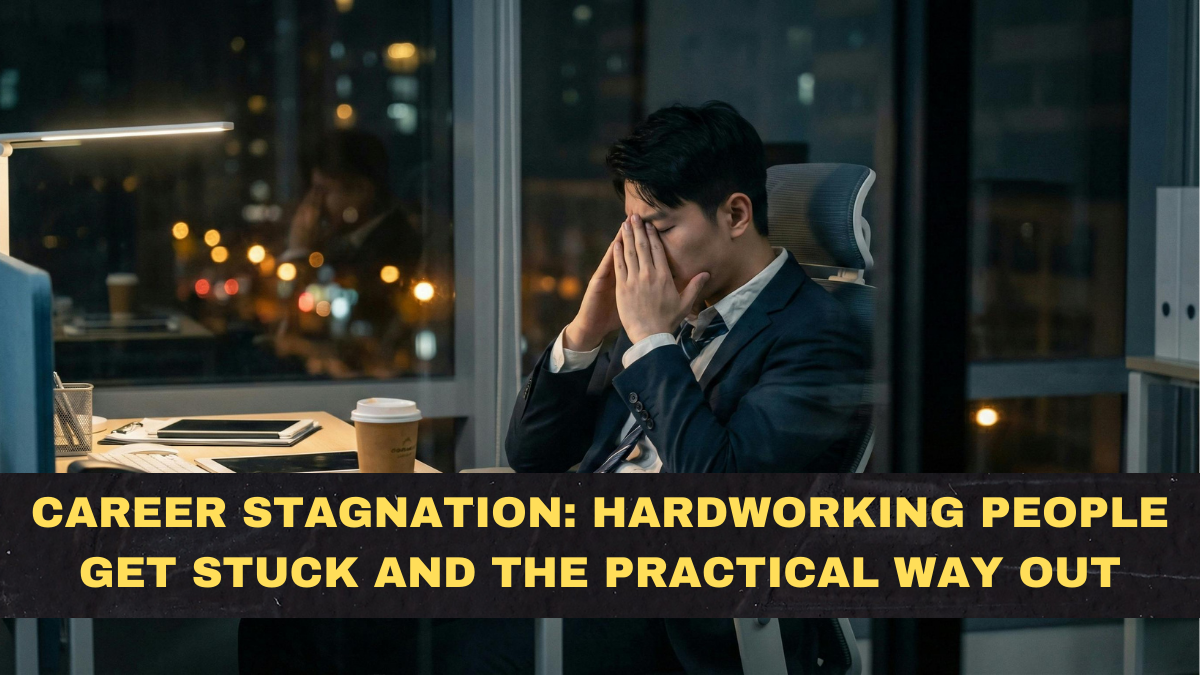
Career stagnation has become one of the most frustrating realities for professionals in India in 2026. Many people are working hard, meeting targets, and staying loyal to their roles, yet their salaries, responsibilities, and learning curves seem frozen. This creates a quiet sense of betrayal, where effort no longer appears to translate into progress.
What makes career stagnation particularly dangerous is that it creeps in slowly. There is no sudden failure or dramatic setback. Instead, months turn into years of repeating the same work while watching peers move ahead or switch lanes successfully. Understanding why this happens is the first step toward escaping it without burning bridges or making reckless decisions.
What Career Stagnation Actually Looks Like in 2026
Career stagnation is not always about salary alone. In many cases, professionals feel stuck because their learning has plateaued, their role has stopped evolving, or their contribution is no longer visible.
In 2026, many companies are flatter and leaner. Promotions are fewer, and roles are tightly defined. Even high performers may find themselves locked into execution-heavy positions with little scope for expansion.
Stagnation often feels confusing because performance reviews remain positive, yet nothing materially changes.
Why Hard Work Alone Is No Longer Enough
One of the biggest myths in Indian work culture is that hard work guarantees growth. In reality, organizations reward leverage, not effort.
If your work does not scale, automate, reduce cost, or directly impact revenue, it may not trigger advancement. Many hardworking employees remain stuck because their contribution is replaceable or invisible at decision-making levels.
In 2026, growth favors those who solve higher-order problems, not just those who work longer hours.
The Role of Skill Obsolescence
Another major driver of career stagnation is skill decay. Skills that were valuable a few years ago may no longer command premium value today.
Technology, tools, and workflows evolve rapidly, and professionals who stop updating their skill set often fall behind without realizing it. Comfort with familiar tasks creates an illusion of competence while market relevance quietly erodes.
In 2026, continuous skill renewal is not optional. It is a survival requirement.
How Organizational Structure Traps Good Performers
Ironically, strong performers are often more vulnerable to stagnation. Reliable employees get trusted with execution and firefighting, which makes them indispensable but also immobile.
Managers may hesitate to promote or move such employees because replacing them is costly. This creates a trap where competence becomes a barrier rather than a ladder.
Understanding this dynamic helps professionals stop internalizing stagnation as personal failure.
The Salary Band Problem in Indian Companies
Many Indian organizations operate with rigid salary bands and promotion cycles. Once an employee hits the top of a band, further growth requires role change, not just performance.
In 2026, companies are cautious about expanding fixed costs. As a result, employees who do not proactively reposition themselves often remain stuck despite strong reviews.
Recognizing structural limits allows professionals to plan exits or transitions more strategically.
Early Warning Signs You’re Becoming Stagnant
Stagnation rarely arrives suddenly. Warning signs include repetitive work, declining learning excitement, and feedback that focuses only on reliability rather than growth.
Another sign is being excluded from strategic discussions while being overloaded with execution tasks. This signals that your role is being narrowly defined.
Ignoring these signals often leads to deeper frustration later.
A Practical Way Out of Career Stagnation
Breaking stagnation starts with reframing your value. Instead of asking for promotions, professionals should focus on expanding scope.
This means acquiring adjacent skills, volunteering for cross-functional work, and solving problems that leadership cares about. Visibility comes from relevance, not noise.
In parallel, external benchmarking is crucial. Understanding what the market values helps determine whether growth is possible internally or requires a switch.
Why Switching Jobs Is Not Always the Solution
Job switching can reset salary but does not automatically solve stagnation. Many professionals carry the same patterns into new roles.
If the underlying issue is outdated skills or limited scope, switching companies may only delay the problem. In 2026, strategic switching matters more than frequent switching.
Clarity before movement reduces regret.
Building Momentum Without Burning Out
Escaping stagnation requires sustained effort, not sudden bursts. Learning new skills while working full-time demands realistic pacing.
Small, consistent upgrades compound over time. Side projects, certifications, or responsibility expansion gradually reposition your profile.
Burnout delays progress more than slow growth ever does.
Conclusion: Growth Follows Relevance, Not Loyalty
Career stagnation in 2026 is rarely about laziness or incompetence. It is about misalignment between effort and organizational value.
Professionals who understand how value is measured, update skills deliberately, and expand scope intelligently regain momentum. Growth follows relevance, not just loyalty or endurance.
In a fast-changing market, standing still is not neutral. It is a signal to act with clarity and strategy.
FAQs
Is career stagnation common in 2026?
Yes, flatter organizations and slower promotions have made stagnation more common across industries.
Does switching jobs always fix stagnation?
No, switching helps only if accompanied by skill and scope changes.
How long should I stay before worrying about stagnation?
If learning and responsibility stop growing for an extended period, it’s time to reassess.
Can strong performers still get stuck?
Yes, reliable performers are often overused in execution roles, limiting growth.
What skills help break stagnation fastest?
Skills that increase leverage, automation, decision-making, or revenue impact help the most.
Is stagnation a sign to quit immediately?
Not always. First assess whether growth can be created internally before making a move.