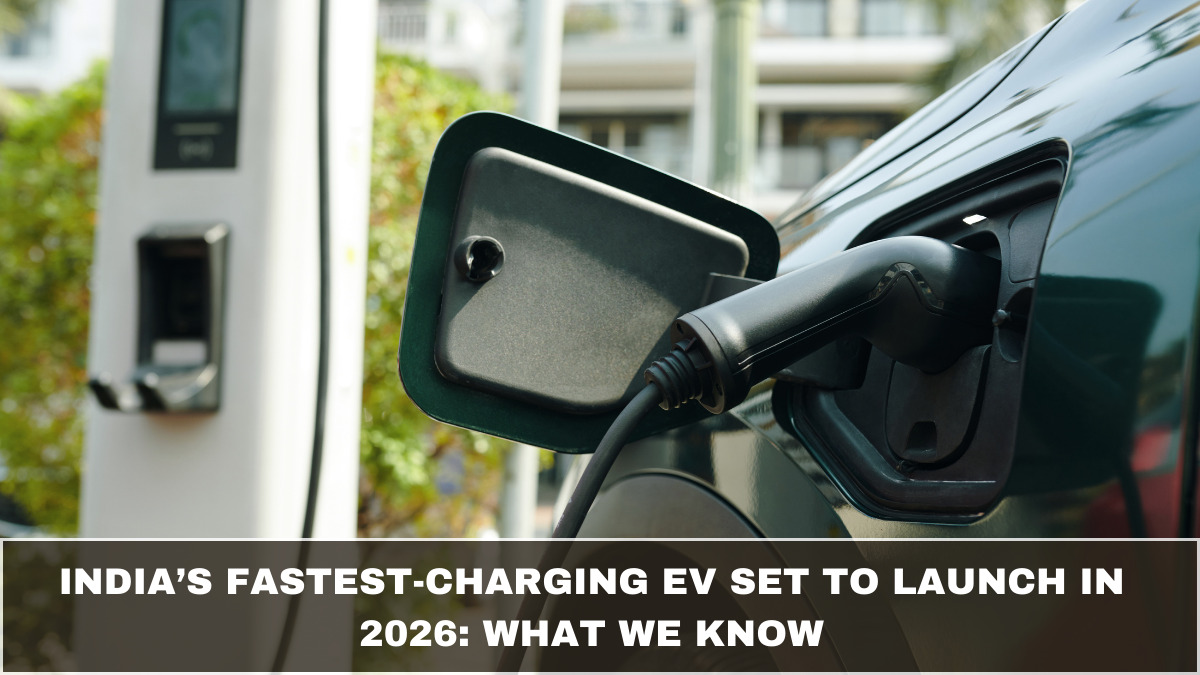
India’s electric vehicle market is preparing for a major shift as the country gets ready to welcome India’s fastest-charging EV in 2026. With consumer interest in EVs rising and manufacturers competing to reduce charging time, this upcoming launch is being seen as a milestone for the Indian automobile industry. While multiple companies are racing to claim the title—ranging from Indian manufacturers to global EV giants—the upcoming 2026 model promises a breakthrough with ultra-fast charging, next-gen battery technology and impressive range improvements. Early industry reports suggest that this EV could become one of the most influential automobile releases of the decade.

Why “Fastest-Charging” Matters to Indian Buyers
Charging time remains one of the largest barriers to EV adoption in India. While range anxiety is slowly reducing due to better batteries, the real concern for most buyers is how long they need to stay plugged in. Today, even premium EVs often require 30–60 minutes on fast chargers, while affordable EVs take hours. This new fastest-charging EV aims to bring charging time down dramatically through next-generation battery chemistry, advanced thermal management and high-capacity charging infrastructure compatibility.
Industry analysts say that a vehicle capable of charging significantly faster than current models will push EV adoption across metros, Tier-1 cities and even smaller towns—especially for buyers who do not have access to home charging setups. Ultra-fast charging can completely change how Indians view long-distance travel, daily usage and EV ownership convenience.
Expected Features & Highlights
Although the carmaker has not publicly disclosed full specifications, early information from industry observers offers a clear idea of what India’s fastest-charging EV may deliver. The model is expected to introduce a range of innovative features focused on performance, speed, efficiency and rapid charging.
Key expected highlights include:
-
Charging from 10% to 80% in under 12–15 minutes
-
Battery pack featuring solid-state or semi-solid-state chemistry
-
Range of 550–650 km on a single charge
-
Support for 350 kW to 500 kW ultra-fast charging stations
-
Regenerative braking system upgraded for Indian city conditions
-
Advanced thermal cooling to maintain battery health
-
Smart connectivity features through an updated EV OS
-
High-strength steel and aluminium body for improved safety
Most experts believe the 2026 EV will blend cutting-edge hardware with AI-based features such as adaptive cruise control, real-time battery health predictions, smart navigation with charger mapping and voice-controlled infotainment.
The Technology Behind the Ultra-Fast Charging Capability
The biggest attraction of this EV is its charging speed, and this improvement is expected due to breakthroughs in battery technology. Traditional lithium-ion batteries face heating issues when pushed to higher charging speeds. The upcoming 2026 fastest-charging EV is reportedly using either solid-state or hybrid solid-liquid electrolyte batteries. These batteries can accept higher charging currents with minimal heat generation, allowing faster energy absorption without degrading long-term performance.
Thermal management will play a key role as well. The EV is expected to use a combination of liquid cooling, energy-efficient heat pumps and AI-driven temperature regulation. This ensures optimal battery temperature, allowing ultra-fast charging even in India’s hot climate. Improved BMS (Battery Management System) sensors can monitor each cell in real-time, distributing charge more accurately to prevent overheating.
Support for 350 kW or higher charging networks also means that as India expands its EV infrastructure by 2026, this model will be future-ready. The shift toward CCS2 and upgraded EV charging standards ensures compatibility with upcoming hyperchargers being rolled out by private and public operators.
Design, Interior & Performance Expectations
Along with rapid charging, buyers can expect a premium design language. Reports suggest a sleek aerodynamic body with sharp edges, thin LED lamps, a panoramic sunroof and a futuristic grille-less front. Aerodynamic efficiency helps increase range, especially at highway speeds, making the EV practical for long journeys.
Inside, the cabin is expected to feel futuristic. This may include:
-
A digital cockpit with dual screens
-
Premium ventilated seats
-
Wireless phone charging
-
AI-powered virtual assistant
-
Over-the-air updates for software and performance tuning
-
Minimalistic dashboard with recycled sustainable materials
Performance-wise, the EV may deliver 0–100 km/h in around 4–5 seconds in high-performance variants. A dual-motor setup with all-wheel drive could also be offered, appealing to buyers looking for sporty EVs. Even the base model is expected to feature high torque for quick acceleration in city traffic.
Expected Price of India’s Fastest-Charging EV
Price speculation suggests a wide range depending on the brand and its variant lineup. Experts predict that the base model may start around ₹18–22 lakh for mass-market versions. Meanwhile, premium versions with larger batteries and ultra-fast charging capability may fall in the ₹28–35 lakh bracket.
If the EV comes from a global brand, pricing could go higher, crossing ₹40 lakh for the top variant. Buyers are also expecting subscription-based services such as battery warranties, software upgrades, charging access plans and extended connectivity packages.
Despite being positioned as ultra-modern, the carmaker is likely to target the fast-growing mid-premium EV segment, where Indian consumers seek advanced tech without luxury-segment pricing.
Impact on India’s EV Market
The arrival of India’s fastest-charging EV in 2026 is expected to trigger major competition. Several carmakers are already working on improved charging technology, and this launch will accelerate research, infrastructure investment and innovation.
Key impacts include:
-
Faster rollout of 350+ kW chargers across highways
-
Higher demand for solid-state battery manufacturing
-
Increased interest in long-range EVs
-
Rise of EV-friendly real estate designed with community charging hubs
-
Better adoption in Tier-2 and Tier-3 cities due to quick-charge convenience
The government’s recent EV initiatives—production incentives, battery manufacturing support and highway charging corridor plans—will complement this shift. Analysts predict that 2026 may become the year India achieves large-scale EV transition momentum.
Conclusion
The launch of India’s fastest-charging EV in 2026 marks a transformative moment for the country’s automobile future. With ultra-fast charging, advanced safety features, improved range and modern design, the model aims to remove long-standing barriers to EV adoption. As battery technology evolves and charging networks expand, Indian consumers will experience a new level of convenience and performance in electric mobility. Whether used for city commutes or long highway drives, this upcoming EV promises to reshape the expectations of Indian buyers.
FAQs
How fast will India’s fastest-charging EV charge?
Industry reports suggest a 10% to 80% charge in under 12–15 minutes.
What battery technology will it use?
It is expected to use solid-state or hybrid solid electrolyte batteries for faster charging and better safety.
What range can buyers expect?
The EV may offer a driving range of 550–650 km per charge depending on variant and conditions.
Will it support ultra-fast charging stations?
Yes, it is likely to support 350 kW–500 kW chargers, making it future-ready for upcoming networks.
What will the expected starting price be?
The base model may begin around ₹18–22 lakh, with premium variants going higher depending on features.