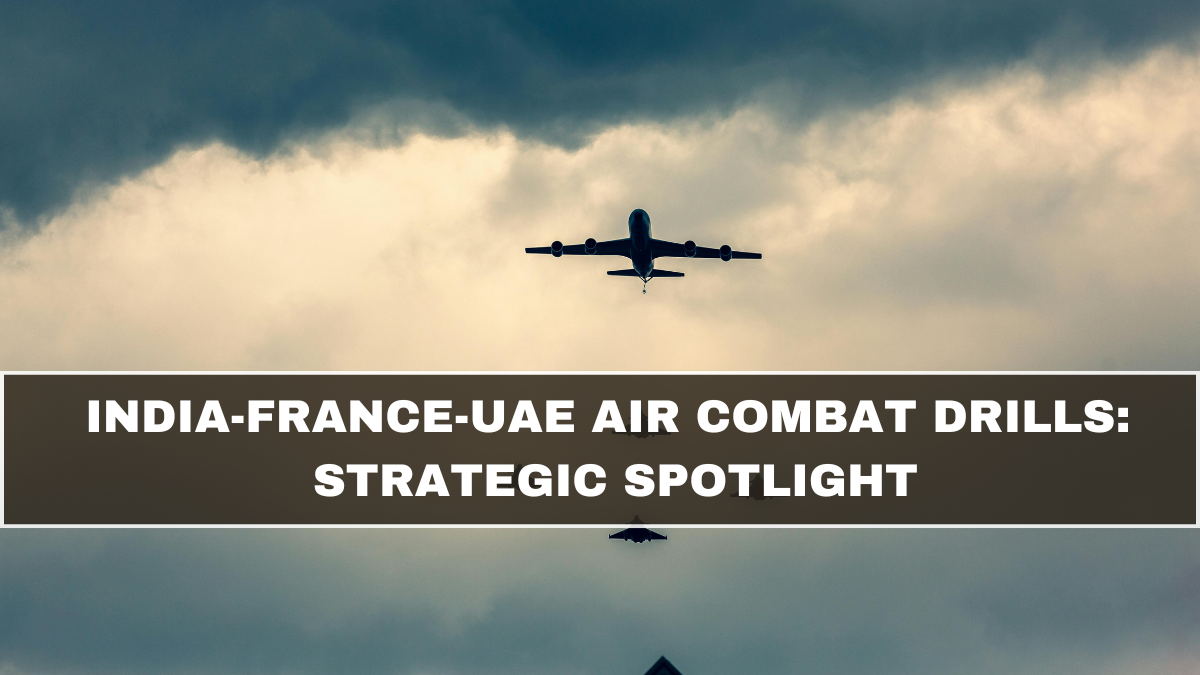
The Joint India-France-UAE drills mark a significant moment in trilateral defence cooperation as the air forces of India, France and the United Arab Emirates come together for coordinated training exercises. Held over several days, these air combat drills involve tactical exercises, information sharing, and interoperability missions designed to enhance the operational capabilities of all three forces.
This collaboration reflects a growing defence partnership between India and key international stakeholders. In recent years, India’s defence relations with both France and the UAE have moved beyond bilateral exchanges to include broader strategic cooperation, particularly in areas relating to air combat readiness, maritime security and defence technology partnerships.
Purpose and Scope of the Air Combat Drills
The Joint India-France-UAE drills serve multiple objectives centered on strengthening aerial warfare preparedness, tactical coordination and mutual trust among participating nations. Key aspects of the exercise include:
• Enhancing joint operational planning and execution
• Conducting air combat simulations involving multiple aircraft types
• Practising airspace management over shared training zones
• Facilitating experience exchange between pilot contingents
• Reinforcing civil/military coordination for crisis response
The exercises feature advanced fighter jets, ground support teams, airborne surveillance and command-and-control units. By rehearsing complex scenarios together, India, France and the UAE aim to improve collective situational awareness and combat readiness in dynamic environments.
Strategic Significance for India
For India, the drills reinforce its commitment to robust defence cooperation and multilateral engagement in regional security matters. India’s air force has steadily expanded its footprint in international training exercises, viewing them as opportunities to sharpen readiness, adopt best practices and build interoperability with friendly nations.
The participation of the Indian Air Force alongside the French Air and Space Force and the UAE Air Force underscores India’s readiness to engage in contemporary defence challenges—from coordinated patrols to complex aerial manoeuvres.
These joint drills also align with India’s broader defence diplomacy goals, which include:
• Enhancing collaborative military training with like-minded countries
• Promoting regional stability through shared expertise
• Demonstrating commitment to collective security partnerships
• Strengthening tactical and strategic air force capabilities
Through these exercises, India reinforces its reputation as a reliable defence partner and demonstrates its capability to operate in coordinated multinational environments.
France’s Role in the Tripartite Drill
France brings extensive experience and advanced technology to the Joint India-France-UAE drills. The French Air and Space Force has been an active participant in international exercises, with familiarity in integrated air defence systems and high-end tactical operations. French involvement adds depth to the exercise through:
• Transfer of tactical knowledge in multi-domain air operations
• Coordinated fighter jet maneuvers in complex scenarios
• Experience with interoperability across different platforms
• Strategic insights into combined planning and execution
For France, participating in this trilateral drill highlights its sustained defence partnerships beyond Europe, especially in the Indo-Pacific and Middle East regions. The exercise serves as an extension of ongoing defence cooperation with both India and the UAE.
UAE’s Growing Defence Engagement
The Emirates’ involvement reinforces the UAE Air Force’s expanding role in regional security initiatives. Over recent years, the UAE has boosted its defence engagement with multiple countries, emphasising training, technology and joint readiness. Its participation in these drills reflects:
• Strengthened defence ties with India and France
• Commitment to multilateral readiness and tactical collaboration
• A broader regional focus on cooperative security measures
The UAE’s strategic geography and growing aerial capabilities contribute to a more comprehensive environment for shared exercises. Training alongside Indian and French forces exposes UAE pilots and support personnel to varied operational doctrines and tactics.
What the Drills Involve: Air Combat & Support Operations
While core to the Joint India-France-UAE drills is sophisticated air combat training, the exercises also cover:
Tactical Formation Flying
Pilots practise coordinated formations to improve situational awareness and precision.
Simulated Engagements
Participants execute mock combat scenarios to test reaction times, strategy and manoeuvrability.
Ground Support Integration
Air missions are conducted with ground control teams to refine communication and mission execution.
Command & Control Exercises
Control units coordinate multiple aircraft movements, reinforcing command effectiveness and interoperability.
Interoperability Workshops
Crew members and pilots from all three nations share operational procedures and tactics to build unified approaches to air missions.
Collectively, these activities help participating forces to develop shared frameworks for mission planning, aerial defence procedures and support logistics.
Impact on Regional Defence Cooperation
The current air combat drills deepen defence cooperation in a geopolitical context where air capabilities, rapid response readiness and aerial surveillance are increasingly vital. India’s engagement with France and the UAE signals a shared interest in stable and secure airspace, particularly in adjoining regions such as the Indian Ocean and the Persian Gulf.
Beyond practical training, these exercises carry diplomatic weight. Multilateral drills help build trust, strengthen ties and establish a common operating rhythm between partner nations, making future collaborations smoother and more effective.
Broader Implications for India’s Defence Diplomacy
India’s involvement in the Joint India-France-UAE drills aligns with its broader defence diplomacy goals which include:
• Expanding military cooperation beyond traditional bilateral partners
• Building high-end training relationships with technologically advanced air forces
• Demonstrating readiness to participate in multinational defence frameworks
• Encouraging strategic stability through combined preparedness
Such drills provide platforms for knowledge exchange that can influence training programmes at home, spur technological upgrades, and support long-term capacity building across service branches.
Conclusion
The Joint India-France-UAE drills are a hallmark of evolving defence cooperation, bringing together three nations with shared interests in regional security, tactical excellence and operational interoperability. Through these air combat exercises, India continues its journey as a proactive contributor to multilateral defence readiness. The drills not only enhance individual capabilities but also build integrated approaches to shared aerial challenges, setting new benchmarks for cooperation among friendly air forces.
FAQs
What are the Joint India-France-UAE drills?
These are coordinated air force exercises involving India, France and the UAE, focused on tactical training, air combat simulations, interoperability and shared defence cooperation.
Why are these drills significant?
They promote defence cooperation, improve operational interoperability, and reinforce strategic partnerships among the participating nations in managing contemporary air operations.
Which forces participate in the drills?
The Indian Air Force, the French Air and Space Force, and the United Arab Emirates Air Force participate, each bringing its own experience, training protocols, and tactical expertise.
What types of activities are included?
The exercises include tactical formation flying, simulated combat engagements, ground support coordination, command and control drills, and interoperability workshops.
How do these drills benefit India?
They enhance India’s air combat readiness, boost tactical coordination with global partners, support defence diplomacy, and provide experience operating in multinational frameworks.
Click here to know more.