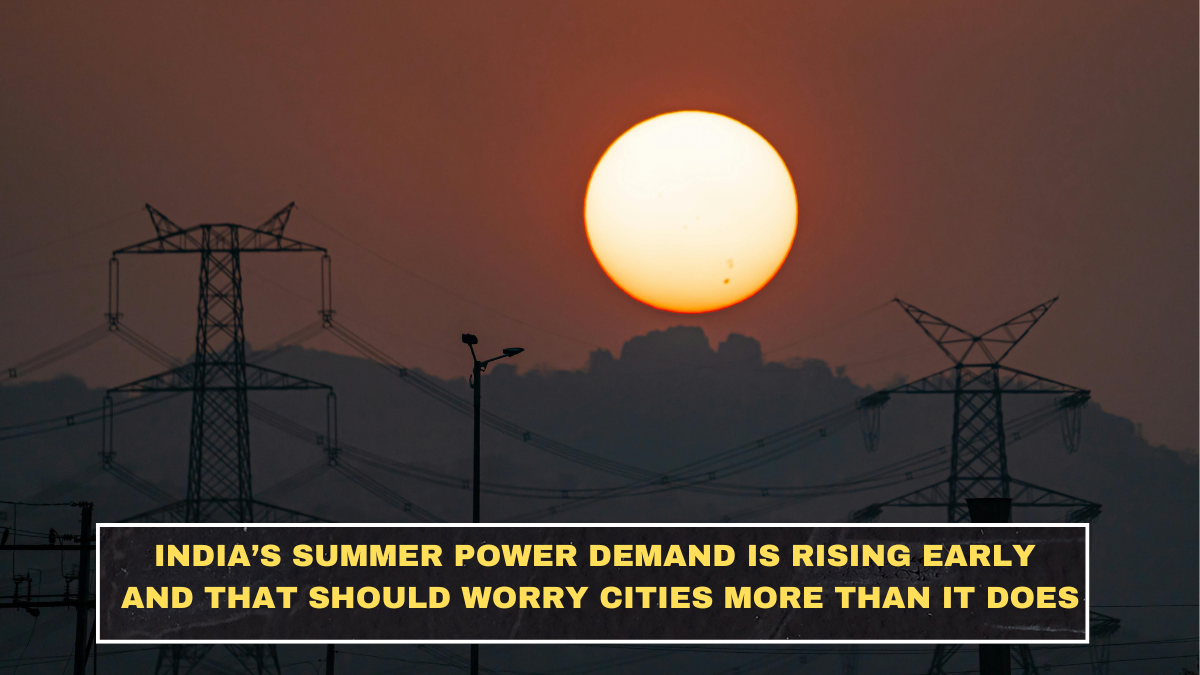
India’s summer power demand is rising earlier than usual, and that matters because the system is already preparing for a record season. The government has said peak demand could touch 270 GW in April to June 2026, while actual peak demand had already reached 245.44 GW by January 2026. That gap shows how much hotter months can still push the grid. This is not alarmism. It is the official reason coal plants, imported-coal capacity, batteries, and renewables are all being pushed harder before peak summer even fully arrives.
Why this year looks more stressful already
The government’s own summer-preparedness note says coal plants have been told to run at maximum output without planned maintenance, Tata Power’s 4 GW imported-coal plant in Gujarat has been directed to operate at full capacity from April to June, and industry has been encouraged to use captive generation to reduce pressure on the grid. Governments do not do that when demand looks normal. They do it when they expect the margin for error to shrink.
The weather signal is also clear. Reuters reported that India is heading into a hotter-than-normal summer with more heatwave days expected in April to June. That matters because cooling demand spikes fast when households and businesses start using fans, coolers, and air conditioners earlier in the season. A hotter March is not just uncomfortable. It drags forward the electricity burden that usually builds later.
What states are already showing
This is not just a national forecast story. States are already seeing the pressure.
In Tamil Nadu, power consumption rose to 428.28 million units and peak demand hit 20,146 MW, the highest so far in 2026. Solar generation also reached a record 55.60 million units, with 7,189 MW evacuated in a day, which helped keep the system stable. In Kerala, peak demand touched 5,836 MW, already above the utility’s earlier April and May estimates. In Karnataka, the state projected March demand of 373.6 million units with a peak load of 18,986 MW. Those are not summer-end numbers. They are early signs.
| Location | Verified 2026 number | What it suggests |
|---|---|---|
| India | Peak summer demand may hit 270 GW | Record national stress likely |
| Tamil Nadu | 20,146 MW peak demand; 428.28 MU use | Summer load is arriving early |
| Kerala | 5,836 MW peak demand | Demand already beat seasonal expectations |
| Karnataka | 18,986 MW projected March peak load | March itself is becoming a stress month |
Why cities should worry more
The lazy response is to assume power will somehow “manage.” That ignores what early demand does to infrastructure. When peaks arrive sooner, utilities have less time to spread maintenance, manage fuel, and balance evening demand. Reuters noted that gas normally supports up to 8 GW during peak periods, but gas supply disruptions have forced India to lean harder on coal, hydro, solar, and storage this year. Coal still accounts for about 75% of generation, which tells you how dependent the system remains on thermal backup when demand jumps.
This is also why consumers should expect more talk around efficient cooling and peak-hour restraint. Kerala’s utility has already asked people to reduce appliance use during 6 PM to 11 PM and keep AC settings at 25°C. That is not symbolism. Evening demand is where solar output drops and grid stress becomes more expensive to manage.
What consumers should actually take from this
A few practical facts matter more than broad panic:
- Early heat is already lifting electricity use in multiple states.
- India is planning for a 270 GW summer peak, which would be a new high.
- Solar is helping during the daytime, but evening demand remains the harder problem.
- Cities with weak local networks will feel the strain faster than national averages suggest. This is where voltage issues and expensive spot-market buying usually show up first.
Conclusion
India’s summer power demand is rising early, and the official response already shows the government knows the risk is real. Record demand forecasts, emergency generation measures, and state-level spikes in Tamil Nadu, Kerala, and Karnataka all point in the same direction: this is not a normal start to summer. The serious issue is not whether India can technically keep the lights on. It is how much stress, cost, and local disruption cities may have to absorb while doing it.
FAQs
What is India’s projected peak power demand for summer 2026?
The government has said peak electricity demand could reach 270 GW in April to June 2026.
Is demand already rising before peak summer?
Yes. Tamil Nadu, Kerala, and Karnataka have already reported strong March demand or peak-load pressure.
Why is early summer demand a bigger problem?
Because it reduces the system’s buffer. Utilities have less time to manage maintenance, fuel supply, and evening peaks before the hottest months fully arrive.
Is solar enough to solve the problem?
Not by itself. Solar helps meet daytime demand, but evening demand becomes harder once solar output falls. That is why storage, coal, hydro, and grid management still matter.