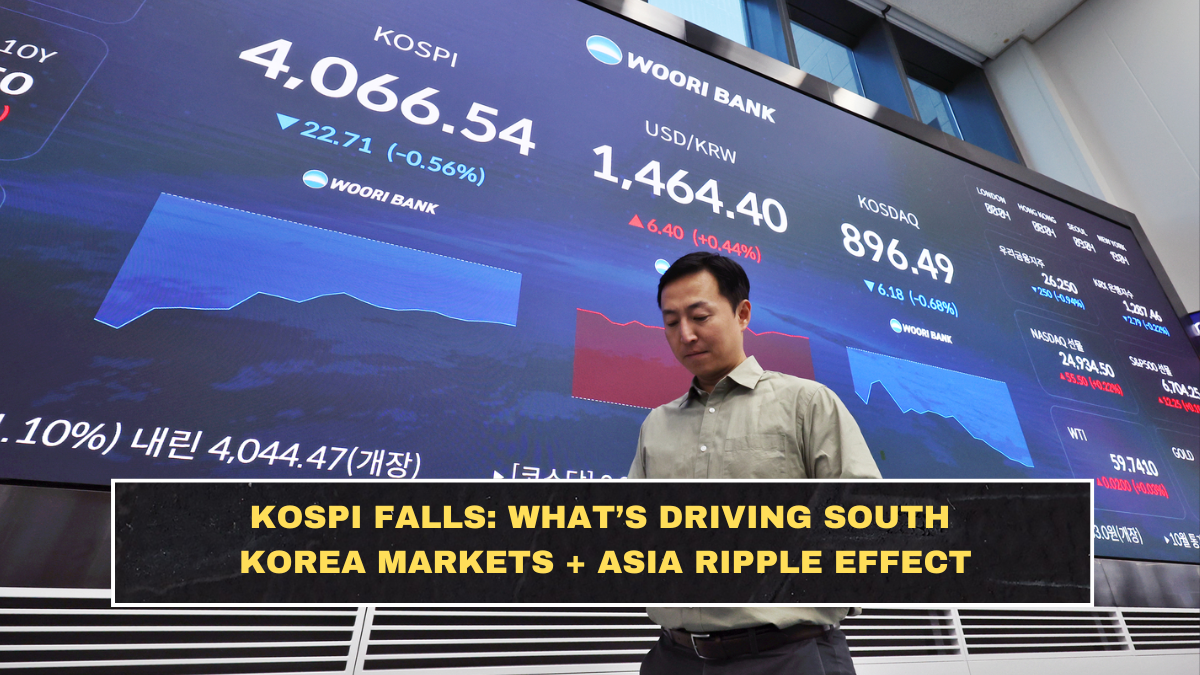
The KOSPI index, which represents the performance of major companies listed on the Korea Exchange, has been moving lower in recent trading sessions. As one of Asia’s most closely watched stock indices, KOSPI often reflects shifts in global economic sentiment, technology demand, and investor confidence in export-driven economies.
South Korea’s economy is heavily tied to global trade, particularly in sectors such as semiconductors, automobiles, and electronics. Because of this strong export orientation, any change in global demand or geopolitical stability tends to influence the KOSPI quickly. When investors become cautious about global growth or technology demand, South Korean equities are often among the first to react.
KOSPI Market Snapshot
The table below shows the latest movement in the KOSPI index during today’s trading session.
| Indicator | Value |
|---|---|
| Opening Level | 2,640 |
| Day High | 2,645 |
| Day Low | 2,605 |
| Current Level | 2,610 |
| Daily Change | -0.85% |
The decline indicates cautious investor sentiment as global economic signals remain mixed.
Major Companies Influencing the KOSPI
The KOSPI index is heavily influenced by large corporations, particularly technology and manufacturing giants. When these companies experience significant stock movements, the entire index can shift noticeably.
| Company | Sector | Weight in Index | Today’s Movement |
|---|---|---|---|
| Samsung Electronics | Technology | High | Slight decline |
| SK Hynix | Semiconductors | High | Moderate decline |
| Hyundai Motor | Automotive | Medium | Stable |
| LG Chem | Chemicals / Batteries | Medium | Slight decline |
Because semiconductor companies have large weightings in the index, movements in the global chip market can significantly influence KOSPI performance.
Key Factors Driving the KOSPI Movement
Several macroeconomic and global market factors are currently influencing the direction of the South Korean stock market.
| Factor | Impact on Market |
|---|---|
| Global Tech Demand | Weak demand pressures semiconductor stocks |
| Rising Oil Prices | Higher production and logistics costs |
| US Interest Rate Outlook | Capital flows shift toward US assets |
| Currency Volatility | Korean won fluctuations affect exporters |
| Global Risk Sentiment | Investors moving toward safer assets |
These elements combine to create short-term volatility in export-driven economies like South Korea.
How the Korean Won Is Affecting Stocks
Currency movements can also influence stock market performance. The Korean won (KRW) often fluctuates based on global capital flows and trade expectations.
| Currency Indicator | Recent Trend | Market Impact |
|---|---|---|
| KRW vs USD | Slight weakening | Exporters benefit |
| Capital Outflows | Increasing | Market pressure |
| Foreign Investor Activity | Mixed | Higher volatility |
A weaker currency can sometimes support exporters, but rapid depreciation may create uncertainty for investors.
KOSPI vs Other Asian Markets
To understand the broader regional sentiment, investors often compare KOSPI performance with other Asian indices.
| Market | Index | Daily Movement |
|---|---|---|
| Japan | Nikkei 225 | -0.30% |
| South Korea | KOSPI | -0.85% |
| China | Shanghai Composite | +0.20% |
| Hong Kong | Hang Seng | -0.75% |
| India | Nifty 50 | Slight decline |
The data suggests that Asian markets are showing mixed performance, with several indices reacting to similar global economic cues.
Why Global Investors Watch the KOSPI
The KOSPI is considered a key indicator of global technology demand because South Korea is home to some of the world’s largest semiconductor manufacturers. When technology stocks decline in South Korea, it can sometimes signal broader shifts in global electronics demand.
Investors and analysts also watch the index because it reflects economic trends in East Asia, a region that plays a critical role in global manufacturing and trade.
What Traders Are Watching Next
Short-term market direction often depends on upcoming economic data and global financial developments.
| Indicator | Why It Matters |
|---|---|
| Semiconductor Demand | Key driver of Korean exports |
| US Federal Reserve Policy | Influences global liquidity |
| Oil Prices | Affects industrial costs |
| Chinese Economic Data | Impacts regional trade |
These indicators will likely determine whether the KOSPI stabilizes or continues experiencing volatility in the coming sessions.
Conclusion
The KOSPI index movement today reflects broader global uncertainty affecting technology stocks, energy costs, and international capital flows. As an export-driven market, South Korea’s stock exchange reacts quickly to global economic signals.
While short-term fluctuations are common, long-term trends in technology demand and global trade will continue to shape the performance of South Korean equities and their influence on broader Asian markets.
FAQs
What is the KOSPI index?
The KOSPI (Korea Composite Stock Price Index) tracks the performance of major companies listed on the Korea Exchange.
Why is the KOSPI falling today?
The decline is mainly linked to global market uncertainty, technology sector weakness, rising oil prices, and cautious investor sentiment.
Which companies influence the KOSPI the most?
Large corporations such as Samsung Electronics, SK Hynix, Hyundai Motor, and LG Chem have significant weight in the index.
Why do global investors track the KOSPI?
Because South Korea is a major exporter of technology products, the KOSPI often reflects global semiconductor and electronics demand.
Does KOSPI movement affect other Asian markets?
Yes, since regional economies are interconnected, movements in major indices like the KOSPI can influence investor sentiment across Asia.