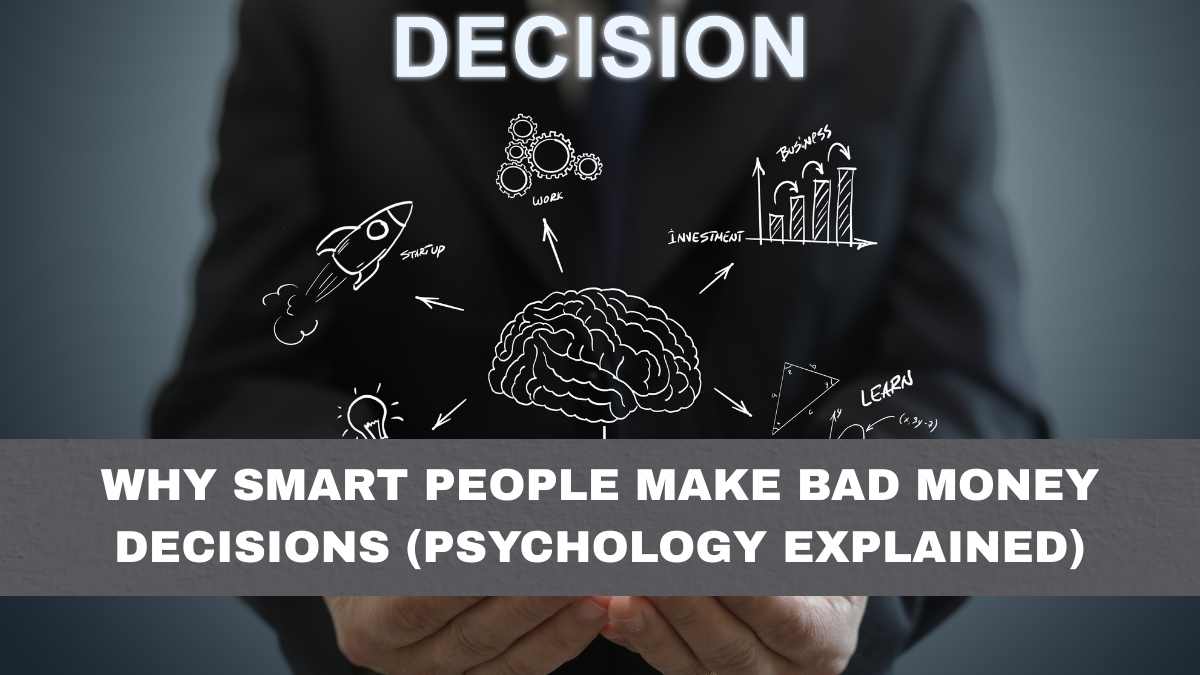
Intelligence doesn’t protect people from financial mistakes. In fact, some of the worst money decisions are made by people who are otherwise rational, educated, and capable. The reason isn’t lack of knowledge—it’s money behaviors psychology. Financial choices are driven less by math and more by emotion, habit, identity, and unconscious bias.
Most people assume bad money decisions come from ignorance. In reality, they come from invisible patterns in spending habits and money mindset that operate beneath awareness. Until those patterns are understood, logic alone won’t fix financial self-sabotage.

Why Money Decisions Are Rarely Rational
Money feels like a numbers game, but the brain doesn’t treat it that way. Financial decisions activate emotional and social centers long before logic steps in.
Money decisions are influenced by:
• Fear and security needs
• Social comparison
• Identity and self-worth
• Short-term emotional relief
• Habitual behavior loops
This is why understanding money behaviors psychology matters more than knowing “what you should do.”
The Role of Emotional Spending
Emotional spending isn’t about recklessness—it’s about regulation. People spend to manage feelings, not finances.
Common emotional triggers include:
• Stress and exhaustion
• Boredom and emptiness
• Reward-seeking after effort
• Anxiety about missing out
These spending habits temporarily soothe emotions, reinforcing the behavior even when regret follows.
Why Smart People Overestimate Self-Control
Highly intelligent people often believe they can “think their way out” of bad habits. This confidence backfires.
Problems arise because:
• Willpower is finite
• Stress lowers self-control
• Habits override intention
Money mindset shifts only when systems change—not when discipline is demanded endlessly.
Mental Accounting and Invisible Leaks
The brain separates money into categories—even when it shouldn’t.
Examples include:
• Treating bonuses as “free money”
• Spending refunds carelessly
• Saving in one account while overspending in another
Mental accounting feels logical but often creates blind spots that undermine long-term goals.
Status Signaling Without Realizing It
Many purchases are less about utility and more about signaling—sometimes to others, often to oneself.
Status-driven spending includes:
• Buying to feel successful
• Matching peer lifestyles
• Avoiding feeling “behind”
These behaviors operate silently inside money behaviors psychology, shaping decisions without conscious intent.
Short-Term Relief Beats Long-Term Logic
The brain prioritizes immediate relief over distant benefits. This is why high-interest debt and impulse purchases persist.
Short-term bias leads to:
• Delaying saving
• Ignoring future costs
• Choosing comfort over strategy
Even smart people fall into this trap when emotional load is high.
Why Budgeting Alone Often Fails
Budgets fail when they fight behavior instead of supporting it.
Common reasons include:
• Overly restrictive rules
• Ignoring emotional triggers
• Treating money as punishment
• Expecting perfection
Spending habits don’t change through restriction—they change through awareness and alignment.
Identity-Based Money Decisions
People spend in ways that reinforce who they believe they are—or who they want to be.
Identity-driven choices look like:
• “I deserve this” spending
• Avoiding saving because it feels limiting
• Overspending to maintain self-image
Money mindset is deeply tied to identity, not just income.
The Scarcity Effect on Financial Thinking
Scarcity—real or perceived—narrows focus. When money feels tight, decision quality drops.
Scarcity causes:
• Tunnel vision
• Short-term thinking
• Poor trade-offs
Ironically, worrying about money often leads to worse financial outcomes.
Why Awareness Changes Everything
Once people see their patterns, shame drops—and control improves.
Awareness allows:
• Interrupting automatic behavior
• Designing better systems
• Reducing emotional triggers
• Aligning spending with values
This is where money behaviors psychology becomes practical.
How to Improve Money Decisions Without Willpower
Better financial behavior comes from redesign, not resistance.
Effective changes include:
• Automating saving
• Reducing decision frequency
• Creating friction for impulse spending
• Aligning money with personal values
Systems outperform motivation every time.
Conclusion
Smart people make bad money decisions not because they’re careless—but because financial choices are emotional, habitual, and identity-driven. Understanding money behaviors psychology reveals why spending habits persist despite good intentions and solid knowledge.
Improving financial outcomes doesn’t require becoming stricter. It requires becoming more aware. When money mindset shifts, behavior follows naturally—and progress finally sticks.
FAQs
Why do intelligent people struggle with money?
Because money decisions are driven by emotions, habits, and identity—not intelligence.
What is money behaviors psychology?
It studies how emotions, biases, and habits influence financial decisions.
Are spending habits hard to change?
They are difficult to change with willpower alone but easier with awareness and system design.
Why does emotional spending feel uncontrollable?
Because it temporarily regulates stress or discomfort, reinforcing the behavior.
What improves money decisions most effectively?
Reducing emotional triggers and building systems that support better choices.
Click here to know more.