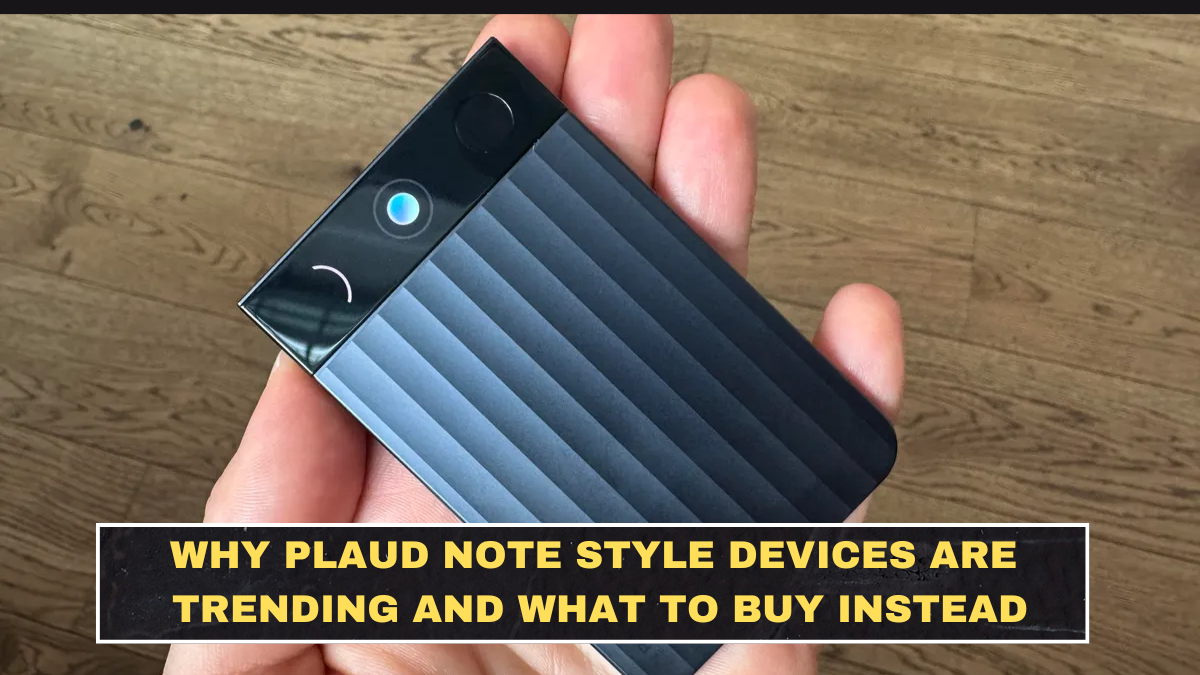
These gadgets are trending because they promise something people actually want: fewer lost details after meetings, calls, lectures, and random conversations. Plaud markets its devices as AI note-taking hardware that can transcribe in 112 languages, generate summaries, and organize notes into structured outputs. It also claims more than 1.5 million users globally, which tells you this is no longer a weird side category for gadget obsessives.
The deeper reason is simpler. Laptop note-taking is clumsy in live conversations, phone recordings are messy, and most people never review raw audio. These devices try to fix that by turning speech into searchable text, summaries, action items, and follow-up material. That is why the category is getting traction with students, founders, consultants, and anyone buried under meetings. It is not because the hardware is magical. It is because the workflow pain is real.

What does Plaud Note actually get right?
Plaud got the category right by making the product feel purpose-built instead of like “just another app.” Its official pages position Plaud Note for hybrid work, calls, and meetings, while newer products such as Plaud Note Pro and NotePin push larger-room capture and more wearable use cases. The original Plaud Note supports up to 30 hours of continuous recording, while recent Plaud materials and Verge reporting describe the Note Pro as adding extra microphones, a small display, and up to 50 hours of recording in endurance mode.
That matters because Plaud is not just selling transcription. It is selling a cleaner capture-to-summary workflow. The device records, the app syncs, and the AI layer turns audio into notes, action items, templates, and searchable memory. That is more appealing than raw voice recorder hardware, and it is also why cheaper alternatives often disappoint. Many competitors can record. Far fewer turn that recording into something useful without adding friction back into the process.
What should buyers compare before picking an alternative?
Most people compare the wrong thing first. They obsess over the gadget shape instead of the actual workflow. The right comparison starts with five questions: how well it captures audio, whether it works for calls and in-person speech, how good the transcription and summary pipeline is, how much the subscription costs, and how portable or wearable the device feels. Even favorable coverage of Plaud has flagged the subscription as a pain point, which is exactly where buyers get trapped after the hardware purchase.
Privacy and context also matter more than buyers admit. Some of these devices are basically “record your life” wearables, which sounds clever until you remember that constant recording creates legal, ethical, and workplace problems. The Verge’s Bee review and Wall Street Journal coverage of Bee, Limitless, and Plaud both show the same tension: the concept can be useful, but the privacy tradeoff is real and sometimes uncomfortable. If a product needs you to record constantly just to feel valuable, that is not a strength. That is a warning sign.
Which Plaud Note alternatives are worth looking at?
The cleanest alternatives right now are not all direct one-to-one replacements. Limitless Pendant is the strongest alternative if someone wants wearable, all-day context capture rather than a MagSafe-style recorder. Limitless describes Pendant as a lightweight wearable with all-day battery, fast USB-C charging, weatherproofing, and continuous conversation memory, but the bigger news is that Limitless announced it has been acquired by Meta. That makes the product interesting, but it also means buyers are now betting on what happens after an acquisition, not just on the current hardware.
Bee is the lower-cost and more experimental option. Verge reviewed Bee as a $49.99 AI wearable that summarizes your day and generates reminders and to-dos, with battery life ranging roughly three to seven days in testing. But that same review also described transcript errors, awkward summaries, and the generally creepy feeling that comes with passive recording. So yes, Bee is cheaper, but cheaper is not the same as better. It is the kind of product that attracts curiosity buyers faster than serious professionals.
How do the main options compare?
| Device | Best fit | Main strength | Main weakness |
|---|---|---|---|
| Plaud Note / Note Pro | Meetings, calls, hybrid work | Mature note workflow, strong summaries, multiple device options | Subscription cost and ecosystem lock-in |
| Limitless Pendant | All-day wearable memory | Lightweight wearable design and continuous context capture | Post-acquisition uncertainty |
| Bee | Budget curiosity and casual memory capture | Low entry price and wearable form | Accuracy, privacy discomfort, and rougher experience |
This is the comparison that matters. Plaud is currently the safest pick for structured meeting notes and work use because its capture-to-summary system is clearer and more mature. Limitless is more ambitious if someone wants a wearable assistant rather than a card recorder. Bee is the budget experiment, not the professional standard. Anyone pretending these are interchangeable is either lazy or selling something.
Who should buy a Plaud Note alternative instead of Plaud itself?
Someone should look beyond Plaud when they need a different form factor or refuse the ongoing cost structure. If the goal is hands-free, continuous capture during the day, a pendant-style product makes more sense than a slim recorder designed around meetings and calls. If the goal is just occasional note support, a lower-cost experimental device may be enough, though buyers should expect more tradeoffs. That is the honest split in this category.
But most buyers are fooling themselves in one of two ways. Either they think hardware will fix their weak note-review habits, or they think the cheapest device will give them the same experience as a better ecosystem. Neither is true. These tools help only when the workflow after recording is strong and the user actually revisits summaries, tasks, and follow-ups. Otherwise, you just bought a shinier pile of unused audio.
Conclusion
Plaud Note style devices are trending because they solve a real modern problem: too much spoken information and too little reliable recall. Plaud currently leads by making the process feel structured and useful, not just novel. Its products combine capture, transcription, templates, and AI summaries in a way that many buyers find easier to trust for work.
The best alternative depends on what you actually need. Choose Plaud if you want the most mature work-focused system. Choose Limitless if wearable memory matters more than meeting-first design. Consider Bee only if price matters more than polish. That is the blunt answer. This category is real, but it is still early, and the wrong purchase usually comes from buying the fantasy instead of the workflow.
FAQs
Is Plaud Note better than just using a phone recorder?
Usually yes, because the value is not just in recording audio. It is in turning that audio into structured notes, summaries, and action items inside a dedicated workflow. That is the part plain phone recordings usually fail at.
What is the biggest downside of Plaud Note style devices?
The biggest downside is the ongoing subscription and privacy tradeoff. Buyers often focus on the hardware price and ignore the recurring AI cost or the discomfort of recording more of their life than they should.
Is Limitless Pendant a serious alternative?
Yes, especially for users who want wearable, all-day memory capture instead of a recorder mainly built around meetings and calls. But the Meta acquisition adds uncertainty about how the product evolves from here.
Are cheaper devices like Bee worth considering?
Only if you are comfortable with weaker accuracy and a rougher first-generation experience. They can be interesting, but they are not the cleanest choice for serious professional note capture.