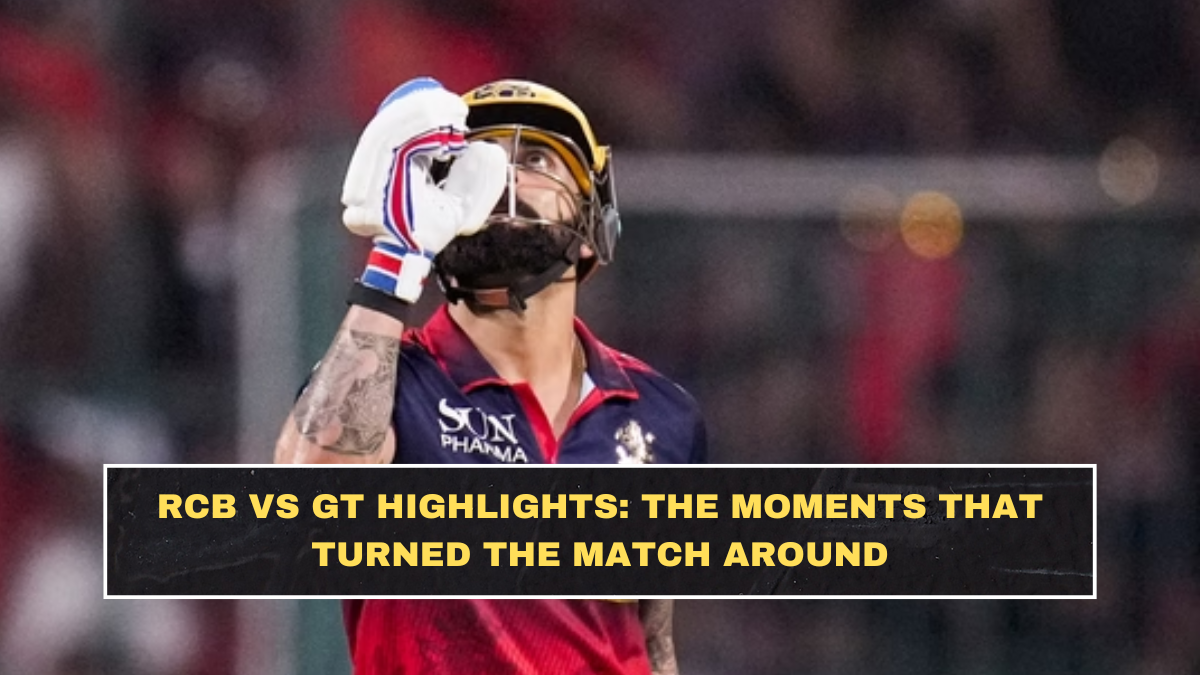
RCB vs GT became one of the biggest IPL 2026 talking points because the match had everything fans usually search for after a high-pressure game: a century, a 200-plus target, Virat Kohli chasing, and a playoff-impact result. Gujarat Titans scored 205 for 3 in 20 overs, but Royal Challengers Bengaluru chased it down by five wickets with seven balls remaining at the M. Chinnaswamy Stadium.
The match turned into a clear example of how T20 games are not won by one big individual score alone. Sai Sudharsan’s 100 off 58 balls gave GT a strong total, but Kohli’s 81 off 44 and Devdutt Padikkal’s 55 off 27 shaped the chase better. That is why the story after the match was not just “GT made 205,” but “RCB controlled a huge chase.”

What Was The Full Match Summary?
The match started with RCB choosing to bowl first, and Gujarat Titans built their innings around Sai Sudharsan’s excellent century. Shubman Gill supported him with 32 off 24 balls, but GT could not turn the final overs into the kind of explosive finish that usually takes a team beyond 220 at Chinnaswamy. That small slowdown became important later.
RCB’s chase was built on clarity. Kohli was dropped early, and Gujarat paid heavily for that mistake. Once Kohli settled, Padikkal attacked from the other end, and their partnership shifted the match sharply toward Bengaluru. Even after a brief middle-order stutter, Krunal Pandya and Tim David finished the chase.
| Match Detail | RCB vs GT Key Number | Why It Mattered |
|---|---|---|
| Venue | M. Chinnaswamy Stadium, Bengaluru | High-scoring ground helped chase |
| GT total | 205/3 in 20 overs | Strong but not fully safe |
| Sai Sudharsan | 100 off 58 balls | Main reason GT crossed 200 |
| RCB target | 206 | Required fast, controlled batting |
| Virat Kohli | 81 off 44 balls | Main chase-builder |
| Devdutt Padikkal | 55 off 27 balls | Gave RCB scoring speed |
| Result | RCB won by 5 wickets | Boosted playoff position |
| Balls remaining | 7 | Chase was controlled, not lucky |
How Did Sai Sudharsan Put GT In Control First?
Sai Sudharsan gave Gujarat Titans a strong platform with a century that mixed timing, placement and clean hitting. His 100 came from 58 balls and included 11 fours and five sixes, which shows that he was not just rotating strike; he was actively pushing the innings forward. On most nights, a century like that should be enough to win a match.
The problem for GT was that Sudharsan’s innings did not get enough finishing support after the main platform was created. Reuters reported that Gujarat had a boundary-less spell from overs 16 to 19, which hurt their final total. That is the part many fans miss: GT reached 205, but with Sudharsan set, they had a real chance to go bigger.
Where Did Gujarat Titans Lose Momentum?
GT lost momentum in the final phase of their innings. In modern IPL conditions, especially at Bengaluru, a team with wickets in hand and a set century-maker usually expects a brutal finish. Instead, RCB’s bowlers controlled most of the death overs with yorkers, slower balls and better discipline, apart from one expensive final over.
This is where the match quietly turned before RCB even started batting. A score of 205 looks massive on paper, but at Chinnaswamy it can become chaseable if the final five overs do not explode. GT did not lose because 205 was poor; they lost because they probably left 15 to 20 runs unused.
How Did Kohli And Padikkal Change The Chase?
Kohli and Padikkal changed the chase by removing panic from a large target. Kohli’s 81 gave RCB control, while Padikkal’s 55 off 27 made sure the required rate did not become ugly in the middle overs. Their partnership was the real turning point because it made 206 feel like a planned chase instead of a desperate chase.
Kohli’s innings also had a storyline because he was dropped in the opening over. That kind of mistake against a player known for run chases is expensive, and GT paid the full price. Once Kohli got rhythm, he punished loose balls and kept RCB ahead of the match equation for most of the chase.
Why Was Kohli’s 81 More Than Just A Half-Century?
Kohli’s 81 mattered because it came in a chase of 206 and at a strike rate of 184.09. That answers the common criticism that experienced anchors sometimes score runs without enough speed. In this match, Kohli gave both stability and tempo, which is exactly what RCB needed.
The innings also pushed Kohli back to the top of the Orange Cap race and added to his IPL milestones. Reports noted that he became the first player to hit 800 fours and 300 sixes for a single franchise. That gave the match extra search value because fans were not only discussing the win, but also his larger IPL legacy.
What Did This Win Mean For RCB’s Season?
This win pushed RCB to second place in the IPL 2026 points table after Match 34, with five wins from seven matches and 10 points. That is a strong mid-season position, especially because their net run rate was reported at +1.101 after the GT win. For a team fighting for playoff control, this was not just entertainment; it was table movement.
But RCB should not get carried away. They still conceded 205, and that is not a small concern. Their batting solved the match, but if the bowling keeps allowing 200-plus totals, they will eventually run into a chase they cannot control. The win was strong, but it also exposed what still needs tightening.
Conclusion?
RCB vs GT became a major IPL 2026 highlight because it had two big individual innings, a high chase and a meaningful points-table impact. Sai Sudharsan’s century gave Gujarat Titans a strong total, but GT’s slower death-over phase left the door open. RCB then walked through that door with Kohli and Padikkal leading the chase.
The match turned on three moments: GT not finishing stronger after Sudharsan’s century, Kohli being dropped early, and the Kohli-Padikkal partnership taking control of the chase. RCB deserved the win because they handled pressure better. GT, honestly, wasted a match where their opener gave them enough to demand victory.
FAQs
Who Won The RCB vs GT IPL 2026 Match?
Royal Challengers Bengaluru won the match by five wickets. They chased Gujarat Titans’ 205/3 with seven balls remaining at the M. Chinnaswamy Stadium in Bengaluru.
How Many Runs Did Virat Kohli Score Against GT?
Virat Kohli scored 81 runs off 44 balls. His innings was the main reason RCB controlled the 206-run chase and moved strongly toward victory.
Who Scored A Century For Gujarat Titans?
Sai Sudharsan scored 100 off 58 balls for Gujarat Titans. His innings included 11 fours and five sixes, but GT still failed to defend the total.
What Was The Biggest Turning Point Of The Match?
The biggest turning point was Kohli being dropped early and then building a match-winning chase with Padikkal. GT also lost momentum during a boundary-less phase from overs 16 to 19.
What Did The Result Mean For RCB?
The result moved RCB to second place in the IPL 2026 points table after Match 34. They reached 10 points from seven matches and strengthened their playoff position.