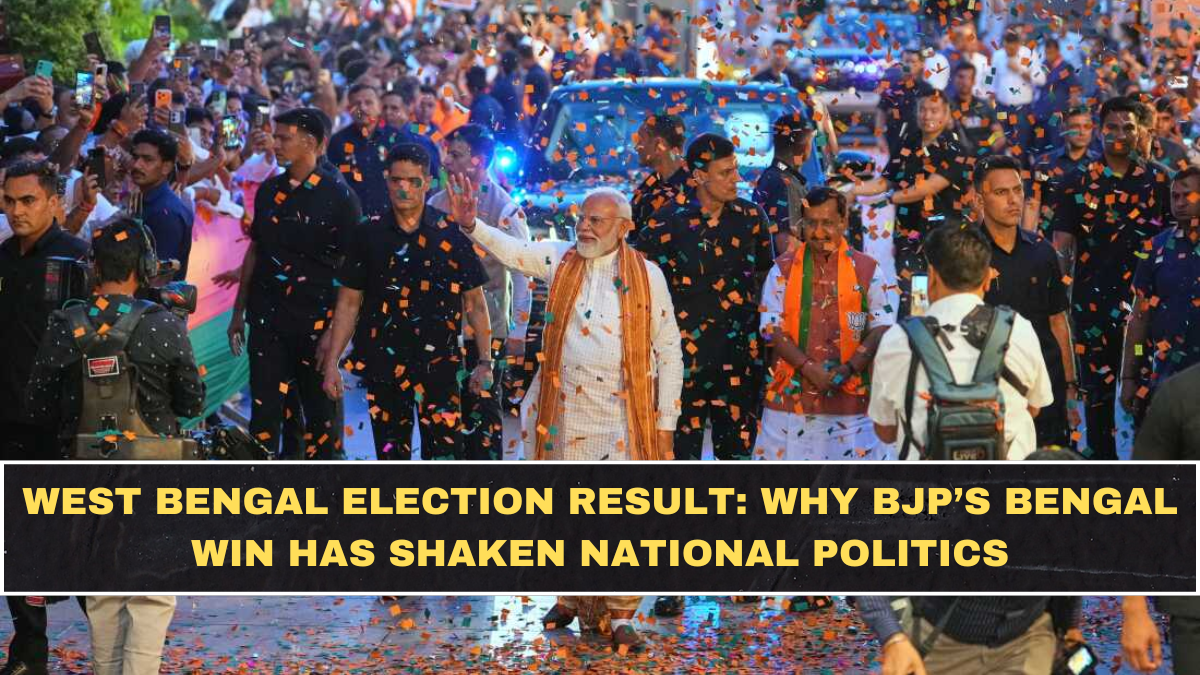
West Bengal has delivered one of the biggest political shocks of 2026, with the BJP crossing the majority mark in a state ruled by Mamata Banerjee’s Trinamool Congress since 2011. According to the Election Commission of India’s May 5 update, BJP was at 206 seats, while AITC stood at 81 in the 294-member Assembly. That number is not just a win; it is a power shift in one of India’s most politically emotional states.
This result matters because Bengal was not seen as just another state election. It was a symbolic battlefield between BJP’s national expansion and Mamata Banerjee’s regional resistance model. AP also reported that this is the first time BJP has won control of West Bengal, making the result a historic moment in Indian politics.

Why Is This So Huge?
Bengal has always been difficult political territory for BJP because the state has a long history of Left politics, strong regional identity and TMC’s grassroots network. For BJP to break through this wall, the party needed more than slogans. It needed booth-level expansion, anti-incumbency, Hindu consolidation, organisational depth and a strong emotional campaign against TMC.
The scale of the result shows that this was not a narrow protest vote. ECI data showed BJP far ahead of TMC, which means the party managed to convert anger, aspiration and local dissatisfaction into seats. Al Jazeera’s analysis pointed to religious polarisation and anti-incumbency as key factors behind BJP’s Bengal sweep.
What Do The Numbers Say?
| Party | Seats Won/Leading | What It Means |
|---|---|---|
| BJP | 206 | Clear majority and first Bengal government |
| AITC | 81 | Major fall after years in power |
| Congress | 2 | Still marginal in Bengal politics |
| AJUP | 2 | Small but visible presence |
| CPI(M) | 1 | Left remains almost wiped out |
| AISF | 1 | Limited minority-space presence |
These numbers are brutal for TMC because the defeat is not only about losing government. It also weakens Mamata Banerjee’s national image as one of the strongest anti-BJP faces. Hindustan Times reported that Mamata Banerjee was among several TMC ministers defeated, which adds another layer of shock to the result.
Why Did TMC Collapse?
TMC’s biggest problem was that its long rule started becoming a burden. After more than a decade in power, any party faces local anger, corruption allegations, fatigue and resentment against ground-level leaders. BJP appears to have converted that anger into a strong “change” narrative, especially in areas where voters felt TMC’s local network had become too dominant.
Another issue was opposition consolidation against Mamata’s style of politics. BJP did not fight Bengal only as a state contest; it framed the election as a battle for political freedom, governance and national alignment. That made the election bigger than local candidates and helped BJP turn Bengal into a prestige fight.
Why Is Mamata’s Reaction Important?
Mamata Banerjee’s reaction matters because the result has already moved from victory to legitimacy debate. Hindustan Times reported that Rahul Gandhi backed Mamata’s “vote chori” claims, while opposition voices raised questions around the mandate. This means Bengal’s political fight may not end with the result sheet; it could continue through protests, legal arguments and street-level mobilisation.
For BJP, the challenge now is not only forming the government. It must prove that it can govern Bengal without turning the state into a permanent conflict zone. For TMC, the challenge is even harder: rebuild credibility, hold its cadre together and stop defections before the party’s political base cracks further.
What Changes Nationally?
- BJP gains the East: Bengal strengthens BJP’s eastern India map after Odisha and Assam.
- Mamata loses national weight: Her role as an anti-BJP anchor becomes weaker after this defeat.
- Opposition unity takes a hit: A major regional force losing badly creates panic before 2029.
- Bengal politics may turn sharper: TMC and BJP rivalry could become more aggressive on the ground.
- CM race becomes crucial: BJP must choose a face who can balance party control and Bengal identity.
This is why the result is not just a state-level development. Bengal sends 42 MPs to the Lok Sabha, and political control in the state can influence national narratives, cadre morale and opposition calculations. A BJP government in Bengal changes the psychological map of Indian politics.
Can BJP Handle Bengal?
Winning Bengal is one thing; governing it is another. The state has strong political emotions, powerful local networks, labour issues, minority concerns, border sensitivities and a history of street-level mobilisation. If BJP treats Bengal like a simple victory trophy, it may quickly face resistance from unions, civil groups and TMC’s remaining grassroots machinery.
The smarter route for BJP will be governance first, revenge later — actually, revenge never. If the party wants to keep Bengal beyond one term, it must focus on jobs, law and order, investment, welfare delivery and corruption control. Otherwise, the same anti-incumbency that hurt TMC can eventually hit BJP too.
What Is The Final Takeaway?
BJP’s Bengal win is a historic political earthquake because it ends TMC’s long rule and opens a completely new phase in eastern Indian politics. The ECI numbers show a decisive mandate, not a tiny edge, which makes this result impossible to dismiss as routine. For BJP, it is a massive expansion moment; for TMC, it is the biggest crisis since its rise to power.
The real story begins now. BJP must prove that it can govern Bengal without deepening political tension, while Mamata Banerjee must decide whether to fight back through organisation, legal challenge or street politics. Bengal has changed hands, but the battle for Bengal’s political soul is far from over.
Frequently Asked Questions
Who won the West Bengal election 2026?
According to the Election Commission of India’s May 5 update, BJP won or led in 206 seats, while AITC stood at 81 seats. This gives BJP a clear majority in the 294-member West Bengal Assembly. The result marks BJP’s first government formation in Bengal, making it a historic political shift.
Why is BJP’s Bengal win important?
BJP’s Bengal win is important because Bengal was one of the strongest non-BJP political spaces in India. The result weakens Mamata Banerjee’s national anti-BJP image and strengthens BJP’s presence in eastern India. It also changes the opposition’s political calculations before future national elections.
What happened to Mamata Banerjee?
Reports said Mamata Banerjee was among the major TMC leaders defeated in the Bengal election. Her party also suffered a huge seat loss after years in power. This has created a major leadership and strategy challenge for TMC, especially as BJP prepares to form the government.
What happens next in West Bengal?
The next major step is BJP choosing its Chief Minister and forming the government. TMC may continue challenging the result politically, especially after opposition leaders raised concerns around the mandate. Bengal could now enter a tense transition phase where governance, law and order, and political stability will be closely watched.