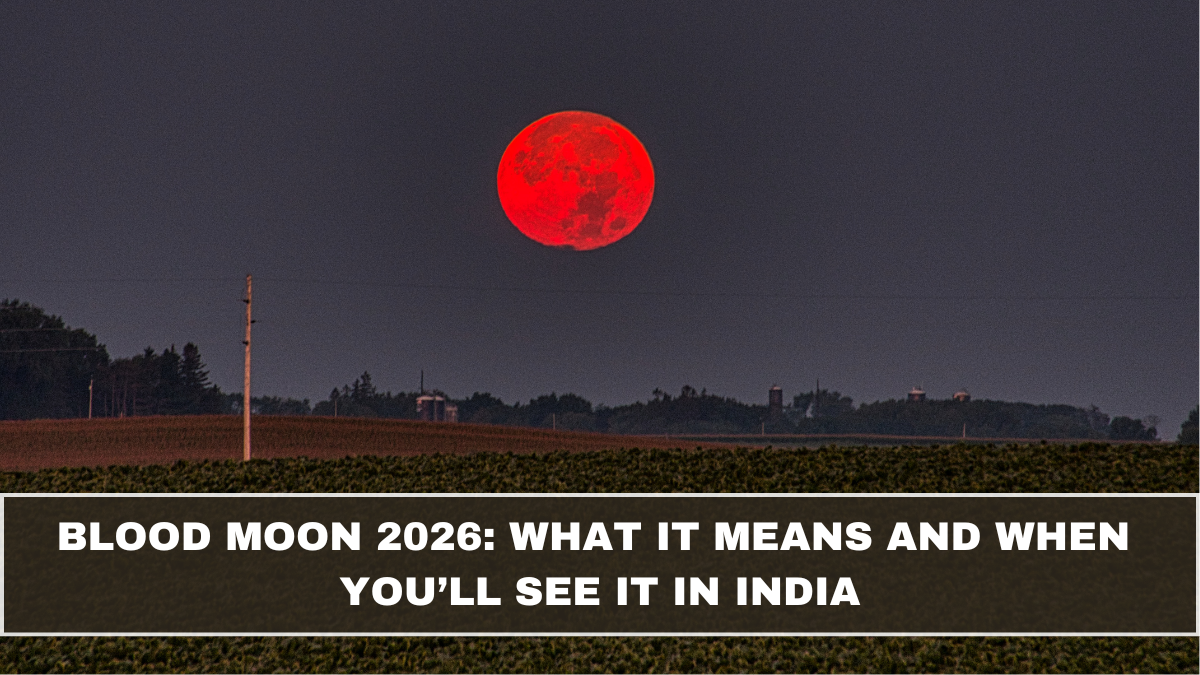
A Blood Moon is a term commonly used to describe the Moon’s reddish appearance during a total lunar eclipse. The phenomenon occurs when the Earth moves directly between the Sun and the Moon, causing Earth’s shadow to fall completely on the Moon while allowing filtered sunlight to create a red glow.
In 2026, interest around the Blood Moon is high due to its connection with lunar eclipse events. Understanding what the phenomenon means, when it occurs, and how it can be viewed helps observers follow the event accurately.
What Is a Blood Moon?
A Blood Moon is not a separate astronomical event but a visual effect that happens during a total lunar eclipse. When sunlight passes through Earth’s atmosphere, shorter wavelengths such as blue light scatter, while red wavelengths bend toward the Moon.
This process causes the Moon to appear reddish or copper-colored during the total phase of a lunar eclipse. The intensity of the red color may vary depending on atmospheric conditions such as dust and cloud particles.
The phenomenon is explained by atmospheric light scattering and is studied in astronomy as part of eclipse observations.
Why the Moon Turns Red During a Lunar Eclipse
During a total lunar eclipse, the Earth completely blocks direct sunlight from reaching the Moon. However, some sunlight still passes through Earth’s atmosphere before reaching the Moon’s surface.
Earth’s atmosphere filters and bends red wavelengths of light toward the Moon, producing the characteristic reddish appearance. This is the same reason sunsets and sunrises often appear red or orange.
The exact shade of the Moon during the eclipse depends on atmospheric clarity and environmental conditions at the time.
Blood Moon 2026 Visibility in India
The visibility of a Blood Moon depends entirely on whether the total lunar eclipse phase occurs during nighttime hours in a specific location. For India, observation is possible only if the total phase of the eclipse happens when the Moon is above the horizon.
Astronomical organizations release official eclipse schedules and visibility maps before the event. These indicate whether the total eclipse phase, which produces the Blood Moon effect, will be visible fully or partially in different regions.
Checking verified astronomical updates ensures accurate information about local visibility.
Difference Between Blood Moon and Lunar Eclipse
A lunar eclipse refers to the entire astronomical event when the Earth’s shadow falls on the Moon. A Blood Moon specifically refers to the reddish appearance of the Moon during the total phase of a lunar eclipse.
Not every lunar eclipse produces a clearly visible Blood Moon. Only total lunar eclipses create this phenomenon, while partial or penumbral eclipses do not show the same effect.
Understanding this distinction helps avoid confusion between the terms.
How to Watch the Blood Moon Safely
A Blood Moon can be safely viewed without any protective equipment because it does not involve harmful solar radiation.
Clear sky conditions and a location with minimal light pollution improve visibility. Binoculars or telescopes can enhance the viewing experience by providing a closer look at the Moon’s surface during the eclipse.
Weather conditions and local horizon visibility play a major role in observation quality.
Scientific and Cultural Interest in Blood Moon Events
Blood Moon events attract attention from both astronomers and the general public due to their rare visual appearance. Scientists use lunar eclipses to study Earth’s atmosphere and light scattering processes.
In India and other cultures, lunar eclipses may also hold traditional or religious significance. Observances vary based on personal beliefs and regional customs.
The event therefore combines scientific observation with cultural awareness.
Conclusion
The Blood Moon 2026 refers to the reddish appearance of the Moon during the total phase of a lunar eclipse. The phenomenon is caused by Earth’s atmosphere filtering sunlight and bending red light toward the Moon. Visibility in India depends on eclipse timing and local viewing conditions. Understanding the scientific explanation, visibility factors, and safe viewing practices allows observers to experience this rare celestial event clearly.
FAQs
What is a Blood Moon?
A Blood Moon is the reddish appearance of the Moon during the total phase of a lunar eclipse.
Does every lunar eclipse create a Blood Moon?
No, only total lunar eclipses produce the reddish appearance known as a Blood Moon.
Will the Blood Moon 2026 be visible in India?
Visibility depends on eclipse timing and location. Official astronomical schedules confirm regional visibility.
Is it safe to watch a Blood Moon with the naked eye?
Yes, a lunar eclipse and Blood Moon can be safely viewed without protective equipment.
Why does the Moon appear red during a Blood Moon?
The red color occurs when Earth’s atmosphere filters sunlight and bends red wavelengths toward the Moon.