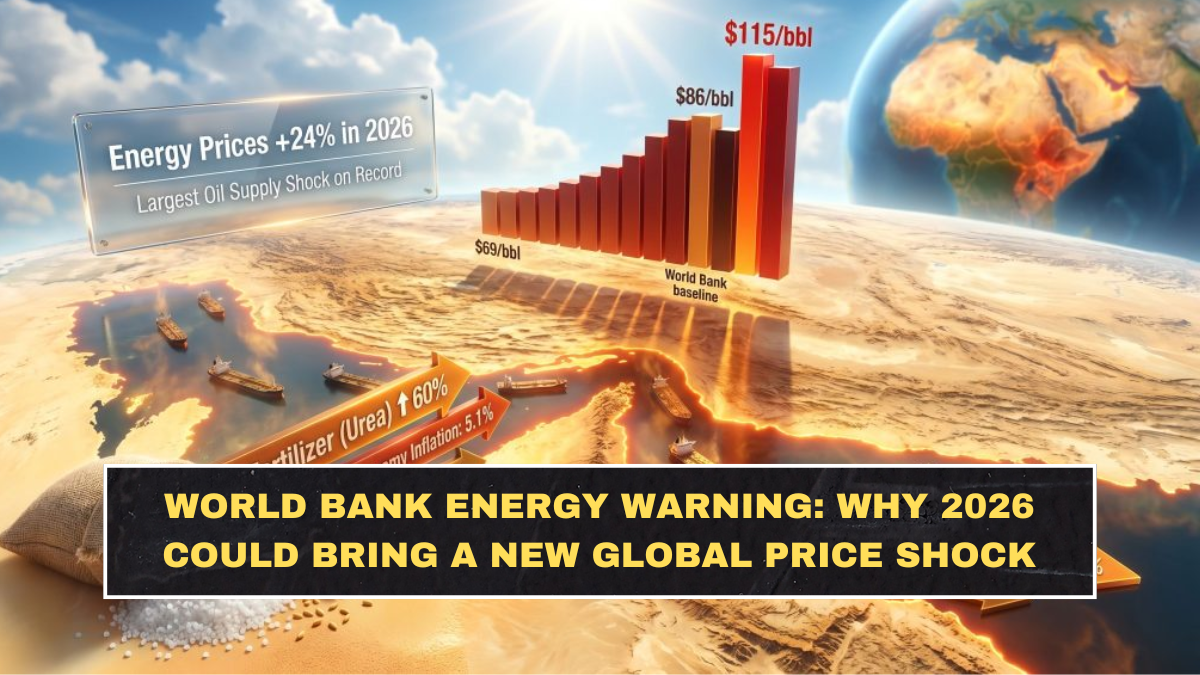
The World Bank has issued a serious warning because the Middle East war has created one of the biggest commodity shocks in years. Its latest Commodity Markets Outlook says energy prices are projected to surge by 24% in 2026, reaching their highest level since Russia’s full-scale invasion of Ukraine in 2022. Overall commodity prices are also forecast to rise by 16%, driven by energy, fertilizer and several key metals.
This matters because energy is not just another market. Oil, gas and fuel costs sit underneath transport, farming, manufacturing, electricity, shipping and household spending. When energy prices rise sharply, the pain does not stay with oil traders. It moves into petrol pumps, food prices, airline tickets, power bills and government budgets.
What Exactly Did The World Bank Forecast?
The World Bank’s baseline forecast says energy prices could rise 24% this year, even if the most severe Middle East disruptions ease and shipping volumes gradually recover. Brent crude is projected to average $86 per barrel in 2026, compared with $69 in 2025. But the warning does not stop there. If the conflict persists or deepens, Brent could rise to $115 per barrel.
That is a huge difference for consumers and governments. A world with $86 Brent is painful. A world with $115 Brent is a serious inflation shock. The World Bank also warned that risks remain tilted toward sharper price increases, meaning the bad scenario is not just theoretical. It depends on war duration, Strait of Hormuz disruption, energy infrastructure damage and how quickly supply routes recover.
| World Bank Warning | What It Means In Simple Terms |
|---|---|
| Energy prices up 24% | Fuel, gas and electricity pressure rises globally |
| Commodity prices up 16% | Raw materials become more expensive |
| Brent crude at $86 | Oil stays much higher than 2025 levels |
| Brent could hit $115 | Severe inflation risk if conflict deepens |
| Fertilizer prices up 31% | Farming costs rise, food prices may follow |
| Developing economies inflation at 5.1% | Poorer countries face worse cost pressure |
Why Is The Middle East War Creating Such A Big Shock?
The Middle East war is creating a big shock because the region remains central to global oil and gas flows. The World Bank described the war as a historic shock to commodity markets, driven by the largest oil supply loss on record. The disruption is linked to attacks on energy infrastructure and pressure on shipping through critical routes such as the Strait of Hormuz.
This is where people often misunderstand energy markets. Prices rise not only when supply is already missing, but also when traders fear future shortages. If tankers face danger, insurers raise costs. If routes become unreliable, buyers panic. If producers cannot ship normally, refineries hunt for replacement crude. That chain reaction is why one regional conflict can become a global price shock.
How Could This Hit Ordinary Households?
Ordinary households could feel the shock through fuel, electricity, cooking gas, transport and food. When oil becomes more expensive, petrol and diesel often follow. When gas becomes expensive, power generation and heating costs can rise. When transport costs rise, businesses pass those costs into everyday goods.
The harsh part is that the poorest households suffer first because they spend a larger share of their income on food, fuel and transport. A wealthy household may complain about higher petrol prices. A low-income household may be forced to cut meals, delay bills or reduce essential travel. That is why energy shocks are not only economic events. They become social and political problems.
Why Are Fertilizer Prices Part Of The Energy Crisis?
Fertilizer prices are part of the energy crisis because fertilizers, especially urea, are closely tied to natural gas and energy costs. The World Bank expects fertilizer prices to rise by 31%, with reports citing a sharp jump in urea prices. That is dangerous because fertilizer affects crop yields, food supply and farmer income.
If farmers use less fertilizer because it becomes too expensive, harvests can weaken later. That means the full impact may not show up immediately. It can appear months later as tighter food supply and higher grocery prices. This is the hidden danger of the energy shock: today’s fuel crisis can become tomorrow’s food crisis.
Why Are Developing Countries Most At Risk?
Developing countries are most at risk because many of them import energy, borrow in foreign currency and have limited money to protect citizens. The World Bank warned that inflation in developing economies could average 5.1%, or rise to 5.8% if the conflict continues. Growth in developing regions is also expected to slow to 3.6%.
This creates a cruel policy trap. Governments may want to subsidize fuel and food, but subsidies are expensive. Central banks may want to cut interest rates to support growth, but higher inflation makes that harder. If currencies weaken, imported fuel becomes even more expensive. Poor and indebted countries get squeezed from every direction.
How Could This Affect Global Growth?
Higher energy prices can slow global growth because they reduce consumer spending and raise business costs. Factories pay more for power, airlines pay more for fuel, farmers pay more for fertilizer, and transport firms pay more for diesel. When costs rise everywhere, businesses delay hiring, consumers cut spending and investors become more cautious.
The Asian Development Bank has already cut its 2026 growth forecast for Asia and the Pacific to 4.7%, down from 5.1%, while raising its inflation forecast from 3.6% to 5.2%. That shows the World Bank warning is not happening in isolation. Other institutions are also seeing the Middle East war move directly into economic forecasts.
Could Central Banks Raise Interest Rates Again?
Yes, central banks could be forced into a harder position if energy inflation keeps spreading. If prices rise too quickly, central banks may delay rate cuts or even raise rates to control inflation expectations. But that can hurt borrowers, businesses and housing markets. This is the worst kind of inflation because it comes from supply pressure, not strong consumer demand.
The problem is simple but ugly. Higher rates do not reopen shipping lanes or produce more oil. They only reduce demand by making borrowing more expensive. So central banks may end up slowing their own economies to fight inflation caused by war. That is why energy shocks are so damaging: they leave policymakers with bad options.
What Is The Bottom Line?
The World Bank’s warning is serious because it shows the Middle East war is becoming a global price shock. A 24% jump in energy prices, a 16% rise in commodities, higher fertilizer costs and possible $115 Brent crude would hit households, farmers, businesses and governments worldwide.
The blunt truth is that energy security is still one of the world economy’s biggest weaknesses. When one region’s war can raise fuel, food and inflation pressure everywhere, the global system is clearly too exposed. If the conflict continues, 2026 could become another year where ordinary people pay for geopolitical failure through higher bills.
FAQs
What Did The World Bank Warn About Energy Prices?
The World Bank warned that energy prices are projected to surge by 24% in 2026 because of the Middle East war, reaching their highest level since Russia’s full-scale invasion of Ukraine in 2022.
What Is The World Bank’s Brent Crude Forecast For 2026?
The World Bank expects Brent crude to average $86 per barrel in 2026, but it could rise to $115 if the Middle East conflict persists or deepens.
Why Are Fertilizer Prices Rising?
Fertilizer prices are rising because energy disruption is pushing up production and input costs, especially for urea. The World Bank expects fertilizer prices to rise by 31%.
How Could This Affect Food Prices?
Higher fertilizer and fuel costs can make farming, transport and food storage more expensive. If farmers reduce fertilizer use, crop yields may weaken and food prices can rise later.
Which Countries Are Most At Risk?
Low-income, indebted and energy-importing countries are most at risk because they have less money to absorb higher fuel, food and borrowing costs.