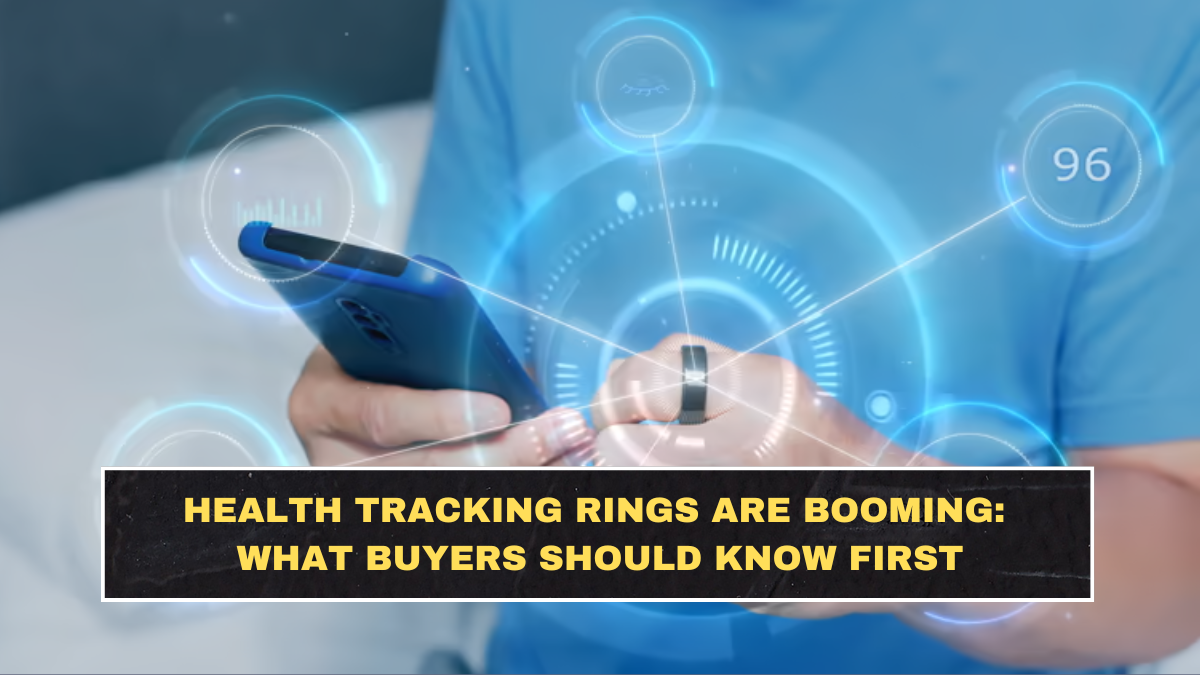
Health tracking rings are growing fast because they solve a problem that many smartwatch users are tired of: bulky devices, distracting screens, and daily charging hassle. Smart ring coverage in 2026 consistently describes the category as one of the fastest-growing wearable segments, driven by people who want smaller devices focused on sleep, recovery, and passive health data rather than notifications on their wrist. That shift matters because many buyers no longer want a mini phone strapped to the body all day. They want quieter tracking.
What Is a Health Tracking Ring?
A health tracking ring is a small wearable worn on the finger that typically measures metrics such as heart rate, sleep, temperature trends, activity, and recovery-related signals. Unlike smartwatches, rings usually lean harder into passive monitoring and battery efficiency instead of apps, screens, and constant interaction. A 2025 systematic review on smart rings in clinical medicine found that smart ring research is split across sleep and non-sleep uses and reported strong measurement performance for heart rate, sleep, and temperature in many settings.
That sounds impressive, but buyers need discipline here. “Tracks health” does not mean “acts like a doctor.” These products are mostly wellness devices, not diagnostic tools. They can be useful for trends, routines, and behavior changes, but they are not a substitute for medical evaluation. The category is getting smarter, yet the safest way to think about a ring is as a personal monitoring tool, not a medical verdict machine.
Why Are Health Tracking Rings Booming Right Now?
The boom is happening because the format is appealing and the timing is right. Consumers increasingly want wearable data without the social and physical friction of a smartwatch, and smart rings offer that in a more jewelry-like form. Forbes reported in 2026 that analysts see smart rings as one of the fastest-growing wearable categories, while buyer guides in 2026 emphasize their long battery life, lightweight feel, and focus on health insights rather than screen-heavy functionality.
There is also a behavior reason behind the trend. People care more about sleep, readiness, stress, recovery, and cycle tracking than they did a few years ago. Rings fit those use cases well because they can collect overnight data comfortably. That is why this category is not just a gadget fad. It is riding the larger shift toward preventive wellness and passive biometric monitoring.
How Accurate Are Health Tracking Rings?
The honest answer is that accuracy is good in some areas and weaker in others. A 2025 systematic review found smart rings showed high accuracy for heart rate, sleep, and temperature, and a 2025 paper comparing the Oura Ring with medical-grade sleep studies concluded that it showed comparable accuracy to polysomnography and actigraphy for commonly measured sleep parameters. That is strong enough to take the category seriously.
But this is where buyers fool themselves. “Comparable” does not mean perfect. A 2026 performance evaluation of consumer sleep trackers reported lower accuracy and agreement in some populations and conditions, and another 2025 paper on ring-based sleep diagnostics said measurement accuracy remains poorly understood in parts of the category. So yes, the data can be useful, especially for trends over time, but no, you should not treat every number as clinical truth.
What Features Should Buyers Actually Care About?
The most useful features are usually sleep tracking, resting heart rate, heart rate variability, temperature trends, recovery or readiness scoring, battery life, comfort, and app quality. Reviews of leading devices in 2026 keep returning to those same points because they affect whether the ring becomes part of daily life or ends up in a drawer. Rings like Oura and Samsung’s Galaxy Ring get attention for health insights, but battery life, fit, sizing, and ecosystem compatibility matter just as much as raw sensor lists.
Here is the buying logic most people ignore: the best ring is not the one with the longest feature list. It is the one whose data you will actually use. If you do not care about recovery scores, stress trends, or cycle data, then paying a premium for those dashboards may be pointless. A wearable that matches your habits beats a “best overall” product that does not fit your life.
| Buying Factor | What to Check | Why It Matters |
|---|---|---|
| Accuracy focus | Sleep, heart rate, temperature trends | These are the strongest common use cases |
| Comfort and fit | Sizing kit, slim design, sleep comfort | Bad fit ruins data quality and wear time |
| Battery life | Several days between charges | Reduces tracking gaps and annoyance |
| App quality | Clear trends, useful insights, not data clutter | Raw numbers alone are not enough |
| Ecosystem limits | Android/iPhone support, brand-specific features | Some rings work better inside one ecosystem |
| Fees | Subscription or no subscription | Real ownership cost can rise quickly |
This table matters because buyers often obsess over style first and recurring cost last. That is backward. If the subscription annoys you or the app is weak, the ring becomes dead weight no matter how pretty it looks.
Are Smart Rings Better Than Smartwatches?
They are better for some people, not better in every way. Rings are stronger when the goal is comfort, passive overnight tracking, long battery life, and less screen exposure. Smartwatches are stronger for workouts, GPS, notifications, calls, and on-device interaction. Reviews in 2026 consistently frame rings as health-first companions rather than full smartwatch replacements for every user.
This is the mistake many shoppers make: they compare a ring to a watch as if one device must win everything. That is lazy thinking. A ring is often the better choice for someone who hates wrist wear at night and mostly wants sleep and recovery data. A watch is often the better choice for someone who runs, navigates, trains, and wants richer live workout feedback. The right answer depends on use case, not trend status.
What Should Buyers Be Careful About?
Be careful about overtrusting scores, underestimating fit, and ignoring ecosystem lock-in. Some devices have stronger functionality inside one phone ecosystem, and some features are still evolving rather than fully mature. There is also a privacy angle: as wearables move closer to health screening and hypertension-risk tools, the amount of sensitive data involved increases. Buyers should look carefully at account model, privacy controls, and whether the company is treating the device as a wellness tracker or inching toward medical-style claims.
You should also be careful with marketing around cycle, ovulation, or advanced recovery promises. These features can be useful, but they are still estimates built from wearable data, not guaranteed answers. When brands advertise certainty, they are often selling confidence more than truth.
Are Health Tracking Rings Worth Buying?
Yes, for the right buyer. A health tracking ring can be worth it if you care about sleep, recovery, passive monitoring, and comfort more than notifications and on-screen fitness coaching. The category has real momentum because it offers a cleaner, less intrusive version of wearable health data. That is a genuine consumer need, not just hype.
No, if you expect medical certainty or a complete smartwatch replacement for training and daily digital convenience. The stronger use case is trend tracking over time, especially for sleep and recovery. If that is what you want, a smart ring makes sense. If you want maps, calls, intense workout metrics, and full-screen interaction, you are shopping for the wrong device.
Conclusion?
Health tracking rings are booming because they fit the way many people now want to use wearable tech: quietly, comfortably, and with more focus on recovery than distraction. The best case for them is strong, especially around sleep and passive data collection. The weak spot is buyer fantasy. These devices are useful, but they are not magic, not perfect, and not a replacement for judgment. Buy one if you want long-term trends and simple daily wear. Skip one if you are just chasing a fashionable health identity.
FAQs
Are health tracking rings accurate enough to trust?
They are accurate enough to be useful for many wellness purposes, especially sleep, heart rate, and temperature trends, but they are not perfect and should not be treated as clinical-grade truth in every situation.
Do smart rings require a subscription?
Some do and some do not. This is one of the most important buying checks because the ongoing cost can change the real value of the device over time.
Are smart rings better for sleep tracking than smartwatches?
For many people, yes, mainly because rings are smaller and more comfortable to wear overnight. That makes consistent sleep tracking easier.
Can a health tracking ring replace medical advice?
No. These devices are wellness tools that may support self-monitoring, but they do not replace clinicians, diagnostic testing, or proper medical care.