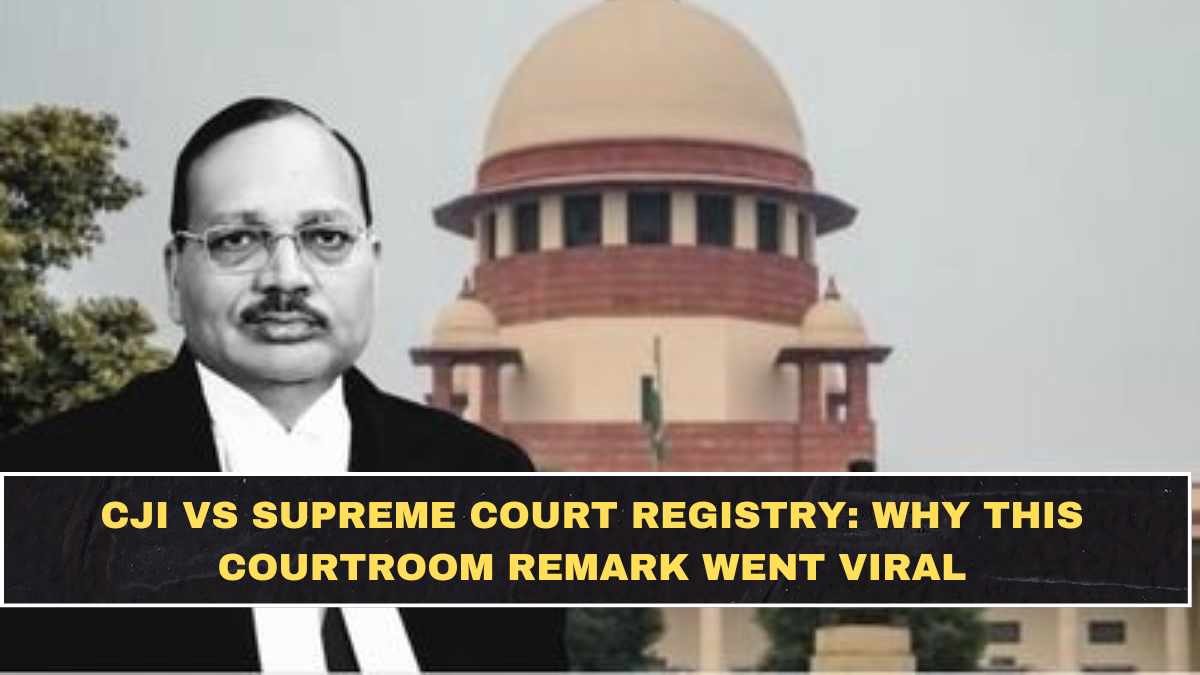
Chief Justice of India Surya Kant’s sharp remarks against the Supreme Court Registry have gone viral because they were unusually direct for a courtroom setting. The controversy began when a Bench of CJI Surya Kant and Justice Joymalya Bagchi noticed that the Registry had failed to issue notice to the Enforcement Directorate despite an earlier judicial direction. The office report reportedly said no such direction had been issued, creating a serious mismatch between the court’s order and the Registry’s record.
The CJI reacted strongly and criticised the Registry’s functioning, saying officials appeared to be acting like a “super Chief Justice of India.” That remark instantly became the headline because it suggested frustration not just with one clerical mistake, but with a deeper administrative culture inside the court system. The Supreme Court has now asked the Registrar Judicial to conduct a fact-finding inquiry and explain how the lapse happened.
What Actually Happened In Court?
The issue arose in a matter where the Supreme Court had earlier directed that notice be issued to the ED. However, during later proceedings, the Registry’s office report allegedly stated that no such direction had been passed. That difference triggered the Bench’s anger because Registry work is not a minor backstage function; it directly affects whether a judicial order is implemented properly.
| Issue | What Happened | Why It Matters |
|---|---|---|
| Judicial direction | Notice was reportedly ordered to ED | Court order needed implementation |
| Registry report | Said no such direction existed | Created record mismatch |
| CJI reaction | Strong criticism in open court | Signalled serious displeasure |
| Next step | Fact-finding inquiry ordered | Accountability may follow |
| Bigger concern | Registry control over case flow | Impacts access to justice |
This is why the controversy matters beyond one viral line. If a judicial order is not correctly reflected or acted upon, parties may suffer delay, confusion or loss of legal opportunity. The court’s anger shows that administrative lapses can become justice-delivery failures if not corrected quickly.
Why Is The Supreme Court Registry So Important?
The Supreme Court Registry handles filing, scrutiny, listing, notices, office reports and procedural movement of cases. In simple language, it is the administrative engine that keeps the court’s judicial work moving. If that engine is slow, inaccurate or opaque, even strong judicial orders can get stuck before they reach practical execution.
This is the blind spot many people miss. The public focuses on judges and judgments, but the Registry decides many practical steps that affect how fast a case moves. A mistake in listing, notice issuance or record preparation can delay justice even when the Bench has already given clear instructions.
Why Did The Remark Go Viral So Fast?
The remark went viral because it was blunt, rare and came from the Chief Justice inside the Supreme Court. Legal reporting platforms noted that the Bench expressed serious displeasure and directed an explanation from the Registry. The phrase used by the CJI sounded unusually sharp, which made it spread quickly across legal circles and social media.
Reasons the row became viral:
- The CJI openly criticised the Supreme Court Registry
- The issue involved failure to issue notice despite a court direction
- The remark sounded unusually harsh for courtroom language
- The matter raised questions about judicial administration
- Legal portals and social media amplified the exchange
The harsh truth is that the viral quote is only the surface-level story. The real issue is whether court administration is transparent, accountable and disciplined enough to handle high-stakes litigation. If the public only laughs at the quote and ignores the system problem, it misses the point completely.
Could This Lead To Real Reform?
It could, but only if the inquiry does more than find one person to blame. The CJI reportedly mentioned that similar concerns about the Registry’s functioning had come up earlier, suggesting the possibility of a deeper problem. That matters because recurring procedural lapses need structural correction, not just temporary embarrassment.
Real reform would mean clearer digital tracking of judicial directions, stronger internal audit systems, faster correction of office reports and better accountability for notice-related errors. The Supreme Court is the country’s highest court, so its administrative machinery must be cleaner than ordinary bureaucracy. Anything less weakens trust in the justice system.
Conclusion: Is This Just A Viral Remark Or A Warning?
The CJI’s sharp comment against the Supreme Court Registry is not just a viral courtroom moment. It is a warning about how administrative errors can interfere with judicial work. When a court direction is not reflected properly and notice is not issued, the issue becomes bigger than paperwork; it becomes a question of institutional reliability.
The honest takeaway is simple: the Registry is not above judicial directions, and its functioning must be accountable. The Supreme Court has ordered a fact-finding inquiry, but the real test is whether this leads to better systems. If the matter ends only as a viral quote, the judiciary will have wasted an opportunity to fix a serious internal weakness.
FAQs
What Did CJI Surya Kant Say About The Supreme Court Registry?
CJI Surya Kant strongly criticised the Supreme Court Registry after it allegedly failed to issue notice to the ED despite a judicial direction. Reports quoted him as saying Registry officials appeared to act like a “super Chief Justice of India.”
Why Was The Supreme Court Registry Criticised?
The Registry was criticised because its office report reportedly stated that no direction had been issued to the ED, even though the Bench said an earlier order had clearly directed notice. This mismatch led the court to seek an explanation.
What Action Has The Supreme Court Ordered?
The Supreme Court has directed the Registrar Judicial to conduct a fact-finding inquiry and explain how the judicial direction was not reflected in the Registry’s records. The inquiry is expected to look into the administrative lapse.
Why Does This Registry Row Matter?
The row matters because court administration directly affects justice delivery. If notices are not issued or orders are not properly recorded, cases can be delayed and parties may suffer. That makes Registry accountability essential, not optional.