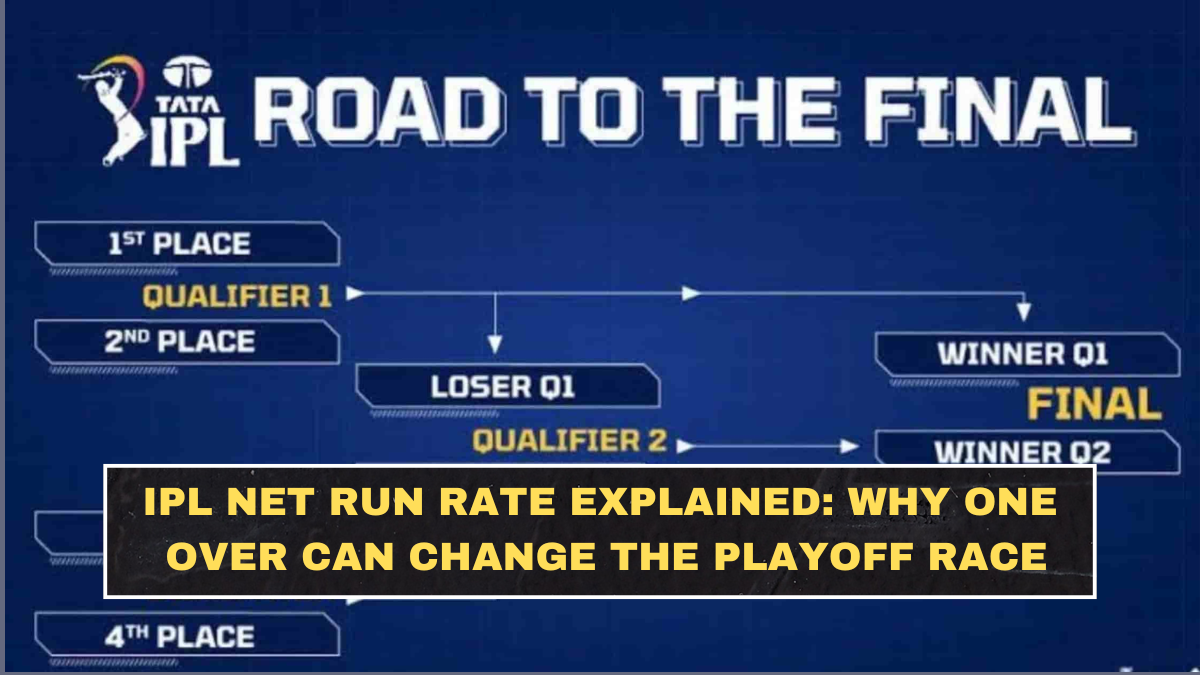
Net run rate, or NRR, is the number that separates teams when they finish with the same points in the IPL points table. In simple words, it compares how fast a team scores runs with how fast that same team allows opponents to score runs. ESPNcricinfo explains it as average runs per over scored by a team minus average runs per over scored against that team.
This is why NRR becomes a playoff pressure point in the second half of the IPL. Two teams can both have 14 points, but the team with the better NRR may qualify while the other team misses out. That is brutal, but it is also why teams keep attacking even after a match looks almost decided. One expensive over, one slow chase, or one heavy defeat can change the table badly.
How Is Net Run Rate Calculated?
The basic formula is simple: team’s batting run rate minus team’s bowling run rate. Batting run rate means total runs scored divided by total overs faced. Bowling run rate means total runs conceded divided by total overs bowled. The official IPL playing conditions use net run rate as a table-separation rule when teams are level on points.
Here is the clean way to understand it. If a team scores faster than it concedes, its NRR becomes positive. If it concedes faster than it scores, its NRR becomes negative. A positive NRR does not guarantee qualification, but it gives a team protection when the points table becomes crowded.
| Match Situation | Runs Scored | Overs Faced | Runs Conceded | Overs Bowled | Match NRR |
|---|---|---|---|---|---|
| Team wins big | 200 | 20 | 150 | 20 | +2.500 |
| Team wins narrowly | 180 | 20 | 175 | 20 | +0.250 |
| Team loses badly | 150 | 20 | 200 | 20 | -2.500 |
| Team chases fast | 181 | 16 | 180 | 20 | +2.313 |
Why Can One Over Change The Playoff Race?
One over can change the playoff race because NRR is based on scoring speed, not just match result. A team that chases 180 in 19.5 overs gets two points, but a team that chases the same target in 15 overs gets two points plus a much stronger NRR boost. That difference can decide qualification later when multiple teams finish on equal points.
This is where many fans make a weak assumption: they think winning is always enough. It is not. In a close IPL season, a team may need to win with margin, not just win somehow. That is why captains sometimes send aggressive batters earlier, continue attacking after reaching a safe position, or try to finish the chase quickly instead of playing slowly.
What Happens If A Team Gets All Out Early?
This is one of the most misunderstood parts of NRR. If a team is bowled out before completing its full overs, the calculation usually treats it as having used its full quota of overs. For example, in a T20 match, if a team is all out for 120 in 16 overs, its run rate for NRR purposes is often calculated as 120 from 20 overs, not 120 from 16 overs. ESPNcricinfo’s explainer also highlights this full-quota treatment when a side is bowled out.
That rule makes collapses even more damaging. A team does not get rewarded for getting out early at a slightly higher scoring rate. Instead, being all out makes the NRR hit worse because the innings is treated as if the full available overs were used. This is why lower-order resistance matters even in lost games. Adding 20 runs and surviving longer can reduce the damage.
How Does A Fast Chase Improve NRR?
A fast chase improves NRR because the winning team reaches the target in fewer overs. Suppose Team A scores 180 in 20 overs. If Team B scores 181 in 19.5 overs, it wins but gets only a small NRR benefit. If Team B scores 181 in 15 overs, its batting run rate becomes much higher, and that gives a stronger NRR boost.
This is why playoff-chasing teams often calculate target overs during a chase. They may know that simply winning is useful, but finishing inside 16 overs could push them above another team on NRR. That does not mean reckless batting is always smart. If a team attacks blindly and loses, it gets zero points and damages NRR. Good teams balance aggression with control.
Why Does A Heavy Defeat Hurt So Much?
A heavy defeat hurts because it damages both confidence and NRR at the same time. Losing by 5 runs is manageable because the scoring rates of both teams are close. Losing by 70 runs or getting chased down in 13 overs creates a large negative swing. In a league table, that negative swing may stay with the team for many matches.
This is why teams keep fighting even when the match is almost gone. A side needing 80 from the last 4 overs may not realistically win, but scoring 45 instead of 20 in those overs can reduce the NRR damage. Fans often call this “meaningless hitting,” but it is not meaningless. In IPL league cricket, damage control can keep a team alive.
Why Is NRR Not A Perfect System?
NRR is useful, but it is not perfect. One major weakness is that it does not consider wickets lost. A team winning by 1 wicket with 5 overs left can receive a bigger NRR boost than a team winning more comfortably but more slowly. ESPNcricinfo has also discussed this criticism, noting that NRR focuses on run rates and does not fully reflect wickets as a resource.
Still, NRR remains popular because it is simple enough for league tables and rewards dominant wins. The alternative systems can become too complex for fans and broadcasters. So, while NRR has flaws, teams know the rule before the season starts. Complaining after losing out on NRR is usually just poor planning.
How Should Fans Read NRR During IPL 2026?
Fans should read NRR along with points, not separately. A team with 12 points and -0.500 NRR is still ahead of a team with 10 points and +1.000 NRR. Points come first. NRR becomes important when teams are tied or expected to finish tied. That is the correct way to read the table.
The smartest shortcut is this: positive NRR means a team has generally scored faster than opponents, while negative NRR means it has generally been outpaced. But do not overreact after one match. Early in the season, NRR can swing wildly. Later in the season, after more matches, it becomes harder to repair and more important for qualification.
Conclusion?
Net run rate is not complicated once you stop treating it like a mysterious cricket formula. It simply measures whether a team is scoring faster than it is conceding. In IPL 2026, this matters because the playoff race can easily come down to teams finishing on the same points. When that happens, NRR becomes the difference between qualification and heartbreak.
The practical lesson is clear. Teams must not only win; they must win well. They must also lose carefully when a match slips away. One over of poor bowling, one slow chase, or one batting collapse can change the playoff race. That is exactly why NRR remains one of the most important numbers in every IPL season.
FAQs
What Is Net Run Rate In Simple Words?
Net run rate is the difference between how fast a team scores runs and how fast it allows opponents to score. If a team scores faster than it concedes, its NRR is positive. If it concedes faster than it scores, its NRR is negative.
Does Net Run Rate Matter More Than Points?
No, points matter first in the IPL table. Net run rate matters when two or more teams are tied on points. That is when better NRR can push one team above another.
How Can A Team Improve Its Net Run Rate?
A team can improve NRR by winning big, chasing targets quickly, restricting opponents to low scores, and avoiding heavy defeats. Even in a loss, batting deeper and reducing the margin can protect NRR.
What Happens To NRR If A Team Is All Out?
If a team is bowled out before using all its overs, the NRR calculation generally treats it as having used its full available overs. That is why getting all out early can hurt a team’s NRR badly.