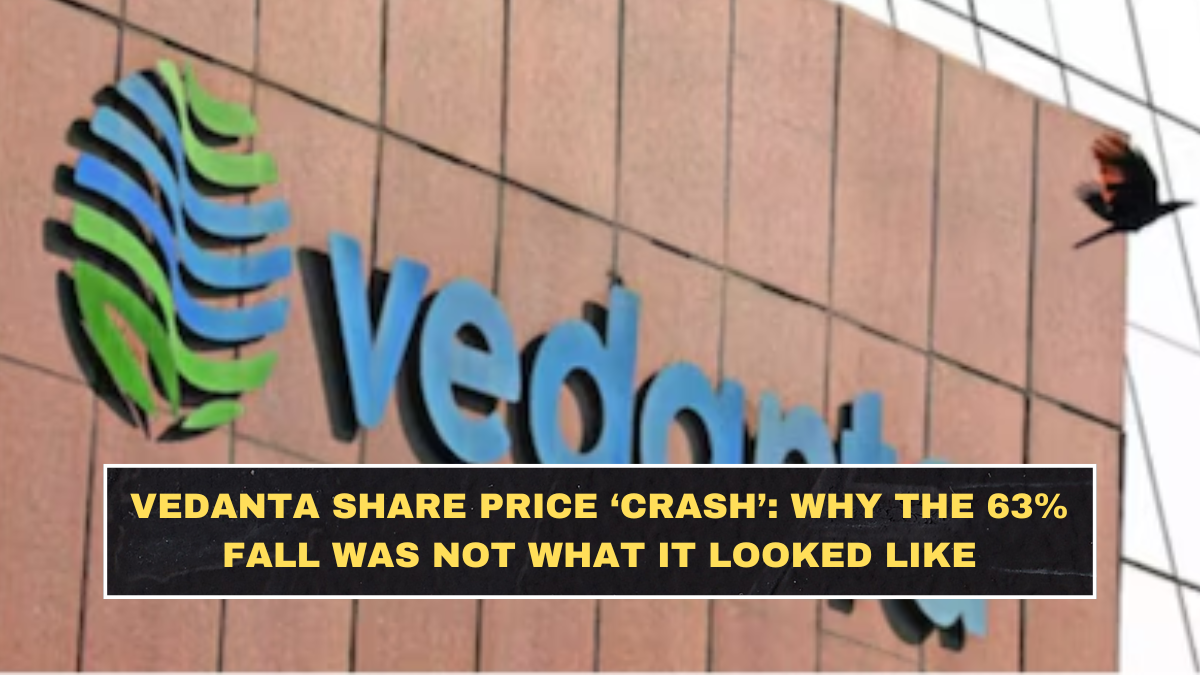
Vedanta shares shocked many retail investors on April 30, 2026, when the stock appeared to fall by around 63% on trading screens. The share price adjusted to ₹289.50 on the NSE after a special pre-open price discovery session, compared with the previous close of around ₹773.60. At first glance, this looked like a brutal crash.
But calling it a normal crash is wrong. The fall was mainly a mechanical price adjustment because Vedanta started trading ex-demerger. In simple words, the stock price was adjusted after removing the value of businesses that are being separated into new companies. Moneycontrol reported that the decline reflected the spin-off of four business verticals, not a sudden destruction of shareholder wealth.
What Does Ex-Demerger Mean In Simple Words?
Ex-demerger means the stock is now trading without the value of the demerged businesses attached to it. Before the adjustment, Vedanta’s share price included the combined value of multiple businesses under one listed company. After the demerger adjustment, the remaining Vedanta share reflects only the residual business value, while eligible shareholders will receive shares in the new separated companies.
This is similar to removing parts from a large business basket and giving them to shareholders separately. The basket becomes smaller, so its visible price falls. But the removed parts do not disappear. They are expected to come back to shareholders as shares of new entities once the process is completed and those companies are listed.
What Will Existing Vedanta Shareholders Receive?
Eligible Vedanta shareholders are set to receive one share each in four newly demerged entities for every one Vedanta share they hold as of the record date. Business Today reported that shareholders eligible as of the record date will receive shares in a 1:1 ratio in each of the demerged entities. This is why the visible fall in Vedanta’s share price should not be read as a simple market loss.
The businesses being separated include major verticals such as aluminium, power, oil and gas, and steel-related operations. The idea is to create focused companies so that investors can value each business separately instead of applying one mixed valuation to the entire group. That is the main value-unlocking argument behind the demerger.
| Particular | What It Means For Investors |
|---|---|
| Previous Vedanta close | Around ₹773.60 before adjustment |
| Adjusted price | ₹289.50 on NSE after special session |
| Visible fall | Around 63% on trading apps |
| Real reason | Ex-demerger price adjustment |
| Shareholder benefit | One share each in four new entities |
| Record date | May 1, 2026 |
| Key warning | Do not treat it like a normal crash |
Why Did Trading Apps Show A Scary Red Number?
Many trading apps display price changes by comparing the latest adjusted price with the previous day’s close. That can create panic during corporate actions like demergers, bonuses, splits or special dividends. In Vedanta’s case, the app showed a massive fall because the stock was now trading without the value of separated businesses.
This is a classic retail-investor trap. People look at the red percentage, panic, and assume something terrible has happened. But the correct question is not “Why did Vedanta crash?” The correct question is “What value has been separated, and what will shareholders receive in return?” That difference decides whether the fall is real damage or just accounting adjustment.
Was The Fall Expected Before The Demerger?
Yes, the price adjustment was expected. Analysts had already projected that Vedanta could trade in a much lower range after the demerger adjustment. ICICI Direct estimated before the event that Vedanta’s stock could adjust to around ₹300–₹325 per share after the demerger, compared with the earlier market price above ₹700.
That estimate is important because the actual adjusted price of ₹289.50 was not a random collapse. It was close to the expected post-demerger zone, though slightly lower than some indicative ranges. This proves why investors must read corporate action notices before reacting to price charts. Charts alone can mislead badly on such days.
Does This Mean Investors Lost 63% Of Their Money?
No, not automatically. Investors did not simply lose 63% of their wealth because the lower Vedanta price is supposed to be balanced by the future value of shares in the demerged companies. The final wealth impact will depend on how those new entities are valued when they list and how the remaining Vedanta business performs.
However, investors should not become blindly optimistic either. A demerger creates potential value unlocking, but it does not guarantee profits. Debt allocation, business performance, commodity prices, corporate governance, listing timelines and market sentiment will decide whether shareholders actually benefit. Anyone saying “free money” is oversimplifying the story.
What Should Retail Investors Watch Next?
Retail investors should watch the listing timeline for the demerged entities, the valuation of each new company, and how debt is distributed across the businesses. These details matter because a demerger can look attractive on paper but become complicated if one business carries heavy liabilities or weak earnings visibility.
Investors should also compare the combined market value of the remaining Vedanta share and the new listed entities after they begin trading. That combined value will give a clearer picture of whether the demerger truly unlocked value or only created temporary excitement. Until then, judging the move from one day’s price action is lazy analysis.
Why Did Vedanta Choose The Demerger Route?
Vedanta’s demerger plan is designed to separate different business verticals into focused companies. Large conglomerates often trade at a discount because investors struggle to value unrelated businesses under one umbrella. By splitting them, management hopes each business can attract investors who specifically want exposure to that sector.
For example, a fund interested in metals may value an aluminium company differently from one focused on oil and gas or power. This is the core logic behind demergers: simplify the structure, improve transparency, and allow the market to price each business more clearly. But again, execution will matter more than the announcement.
Conclusion?
The Vedanta share price “crash” was not a normal market collapse. It was mainly an ex-demerger adjustment after the stock started trading without the value of four businesses being separated into new entities. Existing eligible shareholders are expected to receive shares in the new companies, which is why the 63% fall does not tell the full story.
Still, investors should not switch off their brain just because the fall was technical. The real test will come when the demerged companies list, debt details become clearer, and the market values each business separately. Until then, the smart move is to understand the corporate action, not panic over a misleading red number on a trading app.
FAQs
Why Did Vedanta Share Price Fall 63%?
Vedanta share price fell around 63% because the stock started trading ex-demerger after a special price discovery session. The fall reflected the removal of value from businesses being separated into new companies, not a normal one-day destruction of shareholder wealth.
Will Vedanta Shareholders Get New Shares?
Yes, eligible Vedanta shareholders are expected to receive one share each in four newly demerged entities for every one Vedanta share they hold as of the record date. These shares will represent the businesses separated from Vedanta.
Is Vedanta Demerger Good Or Bad For Investors?
The demerger can be positive if it unlocks value, improves transparency and allows each business to get a fair market valuation. However, the final outcome depends on listing prices, debt allocation, commodity cycles and business performance after the split.
Should Retail Investors Panic After The Vedanta Fall?
No, retail investors should not panic only because trading apps showed a 63% fall. But they should study the demerger structure carefully, track the new listings and judge the combined value of all received shares before making any buy or sell decision.