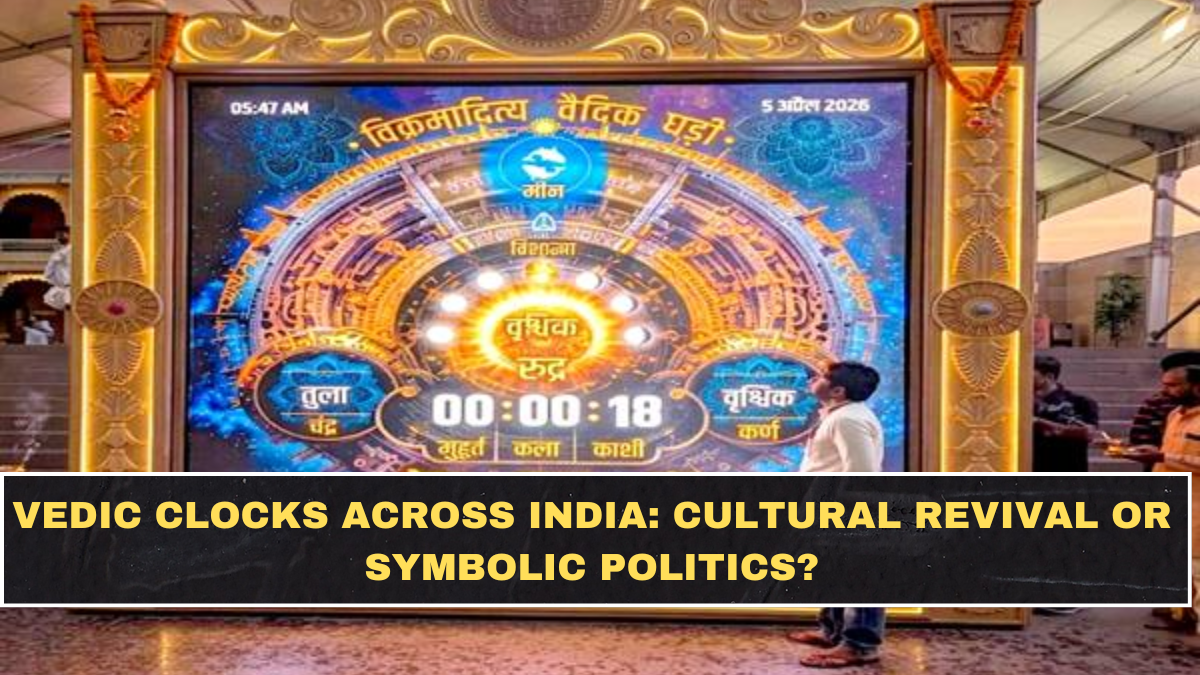
India may soon see Vedic clocks installed at major temples and government landmarks, turning an ancient timekeeping system into a modern public display. Reports say the plan follows the installation of the Vikramaditya Vedic Clock at Kashi Vishwanath Temple in Varanasi, after earlier attention around the Ujjain Vedic Clock project. The clocks are designed to show time through the traditional Indian Panchang system while also displaying modern time formats like IST and GMT.
The idea is attracting attention because it sits exactly between culture, technology and politics. Supporters see it as a revival of India’s older scientific and astronomical traditions. Critics may see it as symbolic messaging in public spaces. The honest answer is that it can be both: a cultural-tech experiment and a political statement, depending on how it is used.
What Makes A Vedic Clock Different?
A normal clock follows the 24-hour system, with the day usually counted from midnight to midnight. A Vedic clock works differently because it is based on the Indian “Kaal Ganana” method and the Panchang tradition. It divides the day into 30 muhurtas, with each muhurta lasting around 48 minutes, and the day is counted from sunrise rather than midnight.
This means the clock is not only telling people the current hour and minute. It can also show tithi, nakshatra, muhurat, planetary details, festivals, eclipses and other Panchang-based information. That is why it is being promoted as more than a decorative clock. It is being presented as a bridge between ancient Indian astronomy and modern digital display technology.
Where Could These Clocks Be Installed?
Reports suggest that the first phase may focus on the 12 Jyotirlingas, followed by other major temples and important government locations. The proposed list reportedly includes places such as Somnath, Mahakaleshwar, the Ram temple in Ayodhya, Parliament, the PMO and Rashtrapati Bhavan. This is what makes the project bigger than a local cultural installation.
| Feature | Vedic Clock Detail |
|---|---|
| System Used | Traditional Indian Panchang |
| Day Count | Starts from sunrise |
| Time Division | 30 muhurtas |
| One Muhurta | Around 48 minutes |
| Extra Display | Tithi, nakshatra, festivals, eclipses |
| Modern Display | IST, GMT and local time |
| First Major Installations | Ujjain and Kashi Vishwanath |
| Proposed Expansion | Jyotirlingas and government landmarks |
Why Are People Calling It A Cultural Revival?
The cultural argument is simple. India has a long history of astronomy, calendars, temple timekeeping and Panchang-based daily life. A Vedic clock puts that knowledge into a visible public format instead of leaving it only inside almanacs, rituals or astrology apps. For visitors at temples, it can become a quick visual way to understand traditional time concepts.
The stronger version of this argument is that modern India often celebrates Western systems while forgetting its own intellectual traditions. A Vedic clock challenges that pattern by saying Indian timekeeping deserves public space too. But there is a weak side as well: if people only click photos and never understand the system, then the clock becomes decoration, not education.
Why Is There A Political Angle?
Anything installed at major temples, Parliament or the PMO cannot be treated as a neutral object. It carries a message. The Vedic clock fits into a larger cultural narrative around heritage, Sanatan traditions and Indian civilisational identity. That does not automatically make it wrong, but pretending there is no symbolism would be naive.
The real question is whether the project will be used to educate people or only to signal cultural pride. If schools, visitors and tourists are given clear explanations, it can become useful. If it is promoted only through slogans, then it risks becoming another headline-friendly installation with limited public understanding.
What Should People Actually Know?
People should not blindly mock the Vedic clock, and they should not blindly worship it either. The concept is historically interesting, but its public value depends on clarity, accessibility and maintenance. A complex clock that ordinary visitors cannot understand will not create cultural learning. It needs simple boards, QR explanations, multilingual content and working digital displays.
Important points to remember:
- It is based on Panchang-style time calculation.
- It does not replace the normal 24-hour clock for daily work.
- It shows traditional time along with modern time formats.
- It may become a tourism and cultural education feature.
- Its success depends on explanation, not just installation.
Conclusion: Is This Useful Or Just Symbolic?
Vedic clocks across India could become a meaningful cultural revival if they are explained properly and maintained seriously. They can introduce people to Panchang, muhurta, tithi and Indian astronomical traditions in a modern visual format. For temples and heritage spaces, this can add genuine educational value if the public is not left confused.
But the project can also become empty symbolism if it is used only for photo opportunities and political messaging. The clock itself is not the problem. The real test is whether India treats it as knowledge infrastructure or just another cultural showpiece. Without public explanation, even the most unique clock will only tell time to people who already understand it.
FAQs?
What Is A Vedic Clock?
A Vedic clock is a clock based on the traditional Indian Panchang system of time calculation. It divides the day into 30 muhurtas, with each muhurta lasting about 48 minutes. It may also display tithi, nakshatra, festivals, planetary positions and modern time formats like IST and GMT.
Where Is The Vikramaditya Vedic Clock Installed?
The Vikramaditya Vedic Clock has been associated with Ujjain and was also installed at the Kashi Vishwanath Temple complex in Varanasi. Reports now suggest that similar clocks may be installed at the 12 Jyotirlingas and major government landmarks. This expansion is why the topic is gaining fresh attention.
Does A Vedic Clock Replace Normal Time?
No, it does not replace normal time used for offices, transport, banking or daily schedules. It works as an additional traditional time display based on sunrise, Panchang and muhurta calculation. Most people will still use the standard 24-hour clock for regular life.
Is The Vedic Clock Scientific Or Religious?
It has both cultural and astronomical roots because the Panchang system is linked to traditional timekeeping, lunar phases and celestial calculations. At the same time, its use in temples gives it a religious and cultural identity. The sensible view is to see it as heritage-linked timekeeping, not as a replacement for modern science.