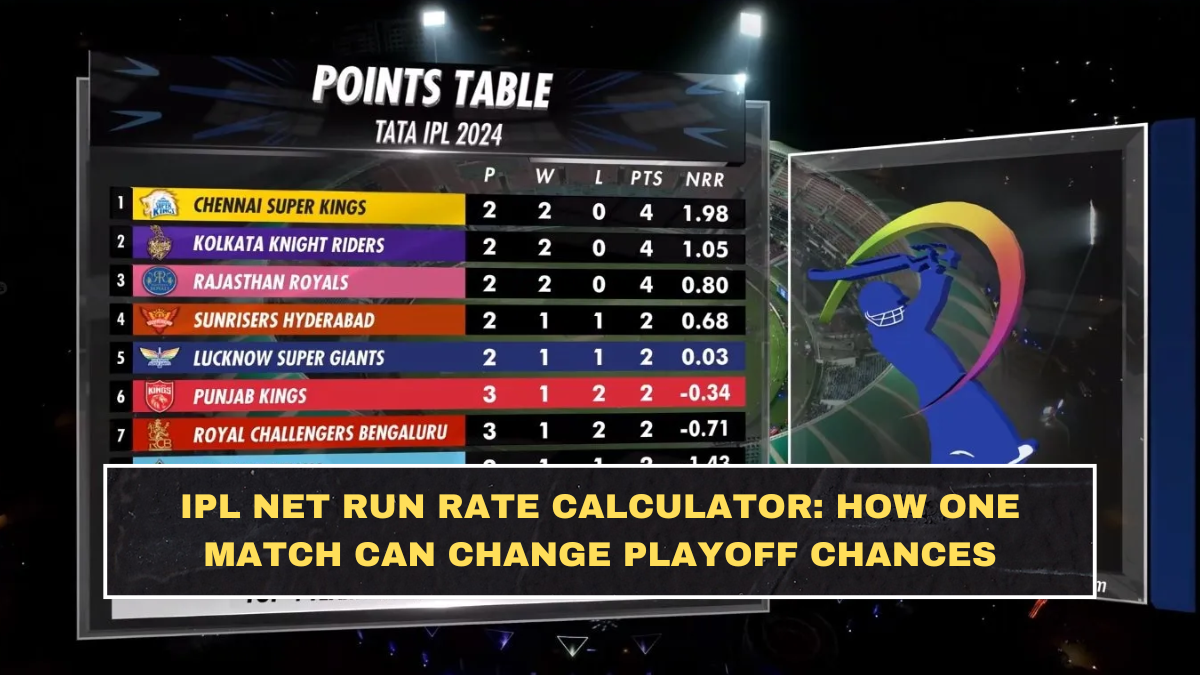
Net run rate, usually called NRR, is the number that separates teams when they are close on points in the IPL table. It is not based on wickets, big names or how exciting a match looked. It is based on a simple comparison: how fast a team scores its runs and how fast it allows opponents to score against it.
The standard cricket explanation is that a team’s net run rate is calculated by subtracting the average runs per over conceded from the average runs per over scored across the competition. ESPNcricinfo explains the same idea: average runs per over scored by a team minus average runs per over scored against that team. That is why NRR becomes so important when teams finish with equal points.

How Is IPL Net Run Rate Calculated?
The formula is simple, but fans often make it messy. A team’s tournament NRR is not calculated by adding match-by-match NRRs. It is calculated using total runs scored and total overs faced across all matches, then subtracting total runs conceded divided by total overs bowled. That is the part many casual fans get wrong.
The basic formula is: team run rate minus opponent run rate. For a single match, if Team A scores 200 in 20 overs, their run rate is 10.00. If they restrict Team B to 160 in 20 overs, the opponent run rate is 8.00. Team A’s match NRR impact is +2.00, while Team B gets -2.00 for that match.
| Situation | Runs | Overs | Run Rate |
|---|---|---|---|
| Team A batting | 200 | 20 | 10.00 |
| Team B batting | 160 | 20 | 8.00 |
| Team A match NRR | 200/20 minus 160/20 | +2.00 | |
| Team B match NRR | 160/20 minus 200/20 | -2.00 |
Why Does One Match Change Playoff Chances So Quickly?
One big win can improve a team’s NRR sharply because the difference between scoring rate and conceding rate becomes wider. If a team wins by 60 runs or chases a target in very few overs, its NRR gets a strong boost. This is why captains sometimes push batters to finish chases early even when the match is already almost won.
The opposite is also true. A heavy defeat can damage a team’s NRR badly, even if the team still has decent points. This is where fans fool themselves by saying, “Only points matter.” No, they do not. In a tight IPL table, points get you into the conversation, but NRR can decide whether you actually qualify.
What Happens If A Team Is All Out Before 20 Overs?
This is one of the most important NRR rules. If a team is bowled out before completing its full quota, the calculation usually treats it as if the team used its full 20 overs in a T20 match. So, if a team is all out for 120 in 15 overs, the NRR calculation does not simply use 15 overs for that innings.
This rule prevents teams from being rewarded just because they lost wickets quickly. It also makes all-out defeats more damaging because the team gets a poor scoring rate over the full allotted overs. Fans who ignore this rule often miscalculate NRR and then get confused when the official table looks different from their manual maths.
How Does A Fast Chase Help NRR?
A fast chase helps because the winning team’s runs are divided by fewer overs. For example, chasing 161 in 16 overs gives a run rate of 10.06. If the same team takes 19.5 overs to score those runs, the run rate becomes much lower. The points are the same, but the NRR benefit is not.
This is why teams with playoff ambitions do not always play safely once they are close to victory. They may attack harder to finish early because every over saved can matter later. In IPL playoff races, a team can miss qualification despite having the same points as another team, simply because its NRR is weaker.
| Chase Scenario | Target Chased | Overs Used | Approx Run Rate | NRR Impact |
|---|---|---|---|---|
| Fast chase | 161 | 16.0 | 10.06 | Strong positive |
| Controlled chase | 161 | 18.0 | 8.94 | Moderate positive |
| Last-over chase | 161 | 19.5 | 8.12 | Smaller positive |
| Failed chase | 150/8 chasing 161 | 20.0 | 7.50 | Negative |
Why Is NRR So Important In IPL 2026?
NRR is important in IPL 2026 because the table is already showing how fast positions can change. After Match 34, RCB’s win over Gujarat Titans moved them to second place with 10 points and a net run rate of +1.101, while Punjab Kings were listed at the top with 11 points and +1.420 NRR in updated tables.
That tells you the playoff race is not just about winning matches. Teams near the top are also building strong net run rates, which gives them protection if the table becomes crowded. A team sitting on similar points but a negative NRR will be under much more pressure in the final league matches.
How Can Fans Calculate NRR At Home?
To calculate NRR manually, you need four numbers: total runs scored by the team, total overs faced, total runs conceded and total overs bowled. Then divide runs scored by overs faced, divide runs conceded by overs bowled, and subtract the second number from the first. That gives the team’s net run rate.
Here is the clean way to think about it. Do not average different match NRRs. Do not add plus and minus numbers from scorecards. Use total tournament numbers. That is the only way to get close to the official calculation, especially after multiple games have been played.
| Step | What To Do | Example |
|---|---|---|
| Step 1 | Add total runs scored | 900 runs |
| Step 2 | Add total overs faced | 100 overs |
| Step 3 | Add total runs conceded | 850 runs |
| Step 4 | Add total overs bowled | 100 overs |
| Step 5 | Calculate scoring rate | 900/100 = 9.00 |
| Step 6 | Calculate conceding rate | 850/100 = 8.50 |
| Final | Subtract both | NRR = +0.500 |
What Is The Biggest Mistake Fans Make With NRR?
The biggest mistake is thinking a narrow win and a big win are equal because both give two points. They are equal in points, but not equal in playoff value. A team that wins by a large margin can build a safety cushion, while a team that keeps winning close games may still stay vulnerable if other teams catch up on points.
Another mistake is ignoring overs. In NRR, balls matter. Finishing a chase in 15 overs instead of 19 overs can be huge. Similarly, getting bowled out early can hurt badly because the full quota rule may apply. This is why NRR looks simple but behaves brutally in real tournament situations.
Conclusion?
IPL net run rate is not complicated once you remove the noise. It measures how fast a team scores compared with how fast it concedes runs. In a normal league table, points come first, but when teams are close, NRR can become the difference between qualification and heartbreak.
For fans, the smartest way to follow IPL 2026 is to watch both points and NRR together. A team with wins and strong NRR is in control. A team with wins but poor NRR is still exposed. That is the uncomfortable playoff maths many fans ignore until it is too late.
FAQs
What Is The Formula For Net Run Rate?
Net run rate is calculated as total runs scored divided by total overs faced, minus total runs conceded divided by total overs bowled. The result can be positive, negative or zero depending on how the team has performed.
Does A Big Win Improve NRR?
Yes, a big win usually improves NRR because the winning team either scores much faster than the opponent or restricts the opponent heavily. The bigger the run-rate difference, the bigger the NRR benefit.
Does A Fast Chase Help Net Run Rate?
Yes, a fast chase helps because the chasing team scores its runs in fewer overs. That increases its scoring rate and improves its net run rate more than a slow chase.
What Happens If A Team Is All Out Early?
If a team is all out before completing its full 20 overs, NRR calculations generally count the full quota of overs. This prevents teams from getting an unfair advantage despite being bowled out quickly.
Why Does NRR Matter In IPL Playoffs?
NRR matters because teams can finish the league stage on equal points. When that happens, net run rate often helps decide which team finishes higher and who qualifies for the playoffs.
Click here to know more